Rotterdam Dockers carry strong momentum into this fixture on the back of three straight victories, while Amsterdam Flames enter under pressure following inconsistent recent displays.
Match Snapshot
Match: Amsterdam Flames vs Rotterdam Dockers, Match 17
Amsterdam Flames vs Rotterdam Dockers: Pitch Report & Weather Conditions
Sportpark Westvliet offers a balanced T20 surface that heavily favors seamers early on. Expect notable swing and seam movement during the Powerplay under local Dutch atmospheric conditions, especially if cloud cover and high humidity persist.
While batting improves as the match settles, scoring remains moderate. Over 39 recorded matches at this venue:
Average 1st Innings Score: 150.6 runs
Average 2nd Innings Score: 132.1 runs
Average Winning Score Batting First: 162 runs
Toss Trend: Teams batting first have won 53.3% of games, while chasing sides claim 46.7%. However, with overcast skies and rain on the radar bringing DLS into the equation, captains may opt to bowl first to take advantage of early seam movement.
Amsterdam Flames vs Rotterdam Dockers Dream11 Prediction: Team Form & Phase Analysis
Rotterdam Dockers (Form: W-W-W)
Cruising with three straight wins behind stable middle-order partnerships.
Top-tier bowling unit controlling both the Powerplay and death overs (Death ER: 8.38).
Powerplay run rate stands at 7.54, losing just 1.25 wickets on average.
Amsterdam Flames (Form: W-L-L)
Heavily dependent on Bas de Leede to anchor and rescue innings.
Aggressive Powerplay approach (run rate: 11.00), but frequent early wickets (1.67 wickets lost per PP) derail their middle-order tempo.
Death-overs bowling has leaked runs consistently, maintaining a 9.89 economy rate.
Amsterdam Flames vs Rotterdam Dockers Dream11 Prediction: Key Player Stats (Last 5 Matches)
Tidy off-spinner providing control in middle overs
Amsterdam Flames vs Rotterdam Dockers Dream11 Prediction
Wicketkeeper: Scott Edwards
Batters: Faf du Plessis, Ben McDermott, Max O’Dowd, Yuvraj Samra
All-Rounders:Bas de Leede (C), Aneurin Donald (VC), Tim David
Bowlers: Logan van Beek, Roelof van der Merwe, Aryan Dutt
Captaincy & Vice-Captaincy Strategy:
Captain (C) – Bas de Leede: Serves as Amsterdam’s batting linchpin and delivers high floor points by bowling crucial middle and death overs.
Vice-Captain (VC) – Aneurin Donald: Boasts an 83.39% boundary share and a 233+ strike rate over his last five games, offering explosive ceiling potential.
Alternative Differential:Logan van Beek, especially if Rotterdam bowls first in overcast conditions where early wickets stack up.
Match Outlook & Projection
Win-probability models tilt heavily toward Rotterdam Dockers (82%–84% win chance regardless of toss). Amsterdam’s projected first-innings total sits at 124–134 runs, while Rotterdam is forecasted to hit 126–136. If Amsterdam cannot protect wickets in the opening six overs, Rotterdam’s clinical bowling should dictate terms.
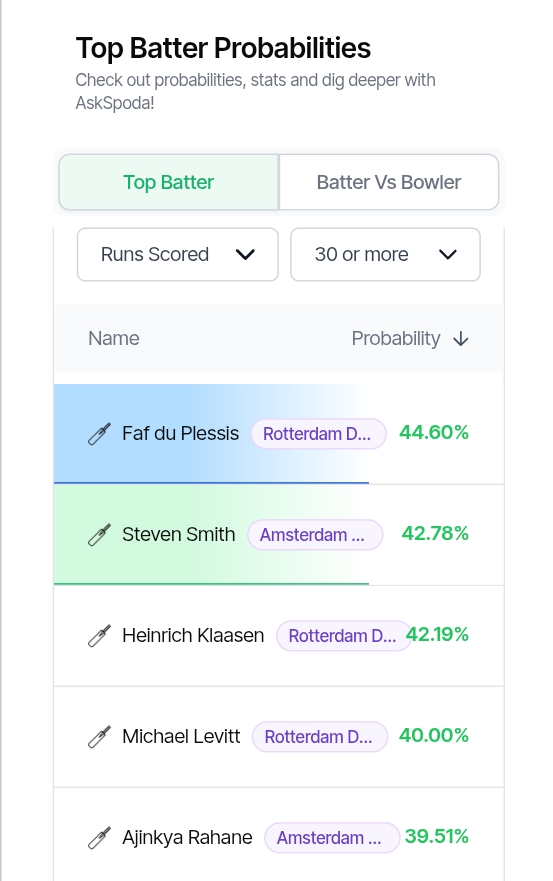
Du Plessis sets the benchmark for aggressive reliability at the top of the order for Rotterdam. With the highest probability on the board, he thrives on dictating terms early and carrying innings deep into the death overs.
The Blueprint: He charges down the deck to fast bowlers to disrupt their length, accessing extra cover and the straight boundaries with supreme bat speed.
Current Form & Analytics: He proved to be the ultimate match-winner in the previous clash between these two sides, smashing an unbeaten 83 off 55 balls (7 fours, 2 sixes) to comfortably chase down Amsterdam’s total.
Why Steven Smith has 42.78% Probability
Smith serves as Amsterdam’s primary tactical spine, bringing world-class composure to absorb pressure and accelerate at will. His 42.78% chance of crossing 30 reflects his knack for building a solid foundation regardless of match conditions.
The Blueprint: He uses deep crease depth and pronounced shuffles across off-stump, whipping deliveries off his pads through mid-wicket or guiding width fine behind point.
Current Form & Analytics: With an extensive T20 pedigree across international and franchise circuits, Smith’s low dot-ball percentage and mastery against both spin and pace give him one of the safest floors to reach the 30-run mark.
Why Heinrich Klaasen has 42.19% Probability
Klaasen is world cricket’s most feared middle-overs weapon, capable of turning any bowling strategy upside down. Even coming in at numbers 4 or 5, his 42.19% probability shows how quickly he accumulates runs when he finds his timing.
The Blueprint: He stands tall in the crease, clears the front leg, and targets the straight and wide long-on boundaries with ferocious hand speed against any spinner who lands it full.
Current Form & Analytics: Operating at a career T20 strike rate well above 150, Klaasen routinely converts starts into high-impact 30+ scores within just 15 to 20 balls, making him an automatic multi-run danger.
Why Michael Levitt has 40.00% Probability
The young Dutch sensation brings pure offensive fireworks alongside Du Plessis at the top. A 40.00% projection highlights his upside in maximizing fielding restrictions during the powerplay.
The Blueprint: Levitt backs away slightly to create room, freeing his arms to launch fast bowling over extra cover and mid-off during the opening four overs.
Current Form & Analytics: Levitt showed his blitz capability earlier this week with a blistering 35 off just 14 deliveries against the Dublin Guardians, striking at an eye-watering 250.00.
Why Ajinkya Rahane has 39.51% Probability
Rahane brings classical elegance and steady pacing to the Amsterdam lineup, serving as an elite stabilizer against moving balls. His 39.51% probability highlights his role in preventing top-order collapses.
The Blueprint: He relies on clean, high-elbow mechanics and punchy footwork, lifting full deliveries over mid-off and punching back-of-a-length pace through backward point.
Current Form & Analytics: Rahane’s recent T20 resurgence has centered on a fearless powerplay approach—taking on the field early before settling into a composed anchor role to cross the 30-run milestone with minimal risk.
Amsterdam Flames vs Rotterdam Dockers – Top Bowlers (2+ Wickets)
Why Kyle Klein has 50.00% Probability
Klein is the linchpin of Amsterdam’s seam setup, consistently landing deliveries in tight channels that force false strokes. At an even 50% chance for 2 or more wickets, the data models position him as the most reliable strike option in this fixture.
The Blueprint: He utilizes a tall, upright release to extract steep bounce from standard back-of-a-length deliveries, cramping aggressive top-order batters looking to pull or cross-bat over mid-wicket.
Current Form & Analytics: Klein showed his high ceiling against this exact Rotterdam lineup on August 26, ripping through the order to claim 3/34 in 4.0 overs. His wicket-taking strike rate in European conditions makes him a lethal two-wicket threat.
Why Jai Moondra has 45.45% Probability
Moondra has emerged as one of the most explosive left-arm pace stories in Associate and European franchise cricket. His 45.45% probability highlights how efficiently his natural angle dismantles right-hand heavy top orders.
The Blueprint: Bowling left-arm fast-medium from over the wicket, he pitches on a full driving length, shaping the white ball back into right-handers to target the front pad and the top of off-stump.
Current Form & Analytics: Moondra burst onto the global scene with a 5-wicket haul across two T20Is against India (including 3/32), and in his overall T20 career he strikes every 9 balls with an outstanding average of 11.94.
Why Anrich Nortje has 43.62% Probability
Nortje brings pure, unadulterated velocity that batters in this league rarely encounter. His 43.62% probability reflects his ability to clean up batting orders simply by blowing past defensive bat speeds.
The Blueprint: Nortje targets the stumps at 90+ mph with heavy lengths, using a skiddy trajectory that rushes pull shots before finishing off innings with toe-crushing yorkers at the death.
Current Form & Analytics: As Rotterdam’s designated middle-and-death enforcer, Nortje consistently attacks the backend of an innings where hitters are forced to take high-risk boundary options, creating automatic multi-wicket upside.
Why David Payne has 40.61% Probability
Payne is a tactical masterclass in T20 bowling, leaning on craft, deceptive angles, and pace variations rather than brute force. His 40.61% odds make him Amsterdam’s veteran safety valve in high-leverage overs.
The Blueprint: He attacks the powerplay by shaping the ball away from right-handers, then shifts to cutters, wide yorkers, and subtle knuckleballs at the death to induce mishits to deep fielders.
Current Form & Analytics: With over 300 career T20 wickets to his name, Payne’s economy and knack for striking in clusters make him a constant two-wicket threat whenever teams look to accelerate late.
Why Richard Gleeson has 38.76% Probability
Gleeson operates with rapid arm speed and hard lengths that catch batters playing early or mistiming aerial drives. A 38.76% probability places him right in the mix to break game situations open.
The Blueprint: He hits the pitch hard on a back-of-a-length corridor just outside off-stump, generating awkward chest-high kick that generates mis-timed pull shots and top edges.
Current Form & Analytics: Gleeson proved his clutch capability during Amsterdam’s win over Dublin Guardians, bagging 2/38 in a tight 20-over defense. His aggressive usage through the middle overs ensures he regularly snags wickets in pairs.
What is the Squad Strength of Amsterdam Flames
The Flames have built their lineup around a high-profile Australian-Dutch core, combining elite international pedigree with proven local Netherlands stars.
Top Order & Leadership: Led by Australian power-hitter Mitchell Marsh, the batting relies heavily on former Australian captain Steve Smith to anchor innings with composure. Youngster Yuvraj Samra and Dutch international Max O’Dowd provide steady support to set a platform.
Finishing Power: Explosive finisher Tim David provides raw lower-order muscle and boundary-clearing ability. He is supported by Dutch national captain Scott Edwards behind the stumps and all-rounder Bas de Leede, who enters as their most in-form batter after tallying 82 runs in the early stages.
Bowling Strength: The seam unit is led by English left-arm quick David Payne and pacer Richard Gleeson, backed by in-form seamer Kyle Klein. In the spin department, off-spinner Aryan Dutt and Kiwi all-rounder Michael Bracewell provide tight lines and middle-overs control.
What is the Squad Strength of Rotterdam Dockers
The Dockers feature heavy South African franchise pedigree blended with seasoned European associate standouts.
Top Order & Leadership: Led by veteran captain Faf du Plessis, the Dockers rely on him to set the tempo from the opening over. He is partnered by dynamic Dutch opener Michael Levitt, creating an aggressive right-handed opening combination capable of exploiting powerplay fielding restrictions.
Finishing Power: The middle and late overs are anchored by premier white-ball hitter Heinrich Klaasen, known for his destructive spin-hitting and boundary conversion rates. All-rounders David Wiese and Logan van Beek provide deep batting depth and boundary power right down to number eight.
Bowling Strength: The bowling is headlined by express pacer Anrich Nortje, who consistently provides breakthrough wickets with sheer pace and lethal yorkers. Veteran campaigner Roelof van der Merwe leads the spin department with tight lines, supported by the wrist-spin variations of Sandeep Lamichhane.
Final Verdict – Today Match Prediction
Rotterdam holds the edge in sheer firepower through Heinrich Klaasen and the express pace of Anrich Nortje, giving them game-breaking ability at both ends of an innings. However, Amsterdam Flames match them with a more balanced batting spine in Steve Smith and lethal finishing from Tim David. If Rotterdam’s top order avoids early collapse, their depth and pace edge make them slight favorites in a close encounter.
Match: Glasgow Cosmics vs Edinburgh Castle Rockers, T20
Date & Time: September 6, 2026 | 3:00 PM IST
Venue: Sportpark Westvliet
Format: T20
Executive Summary & Quick Picks
Key Takeaway: Edinburgh Castle Rockers enter this clash on a 3-match winning streak with a 77%–82% win projection. Overcast and humid conditions at Sportpark Westvliet favor new-ball swing bowlers (Trent Boult, Andrew Tye).
Top Captaincy Choices: JJ Smuts, Jason Roy
Top Vice-Captaincy / Differential: Trent Boult, Gareth Delany
Sportpark Westvliet offers a balanced deck that leans heavily toward pacers during the initial overs.
Early Swing & Seam: Humid and cloudy overhead conditions are forecasted, making the new-ball phase treacherous for top-order batters.
Middle & Death Overs: Batting becomes significantly easier as the ball gets older, rewarding disciplined shot selection and middle-order depth.
Toss Bias: Teams batting first win 53.3% of matches compared to 46.7% chasing. The venue average 1st-innings score is 162, though data-driven projections suggest a tighter, lower-scoring affair today.
Venue Historical Statistics (39 Matches)
Metric
Venue Stat
Matches Played
39
Average 1st Innings Score
162
Average Winning Score (Bat 1st)
162
Highest Successful Chase
179
Scores Above 180+
3 matches
Win % Batting 1st vs Bowling 1st
53.3% vs 46.7%
Glasgow Cosmics vs Edinburgh Castle Rockers Dream 11: Team Form & Tactical Preview
Edinburgh Castle Rockers: Red-Hot Momentum
Recent Form: W – W – W (3 straight wins)
Phase Execution: They maintain a blistering Powerplay run rate of 9.67 and tighten the screws with a miserly death overs economy of 6.00.
Bowling Dominance: With Trent Boult (12 wickets in last 5, ER: 7.78) and Andrew Tye (10 wickets in last 5, ER: 7.41), their pace unit consistently dismantles opposition top orders.
Glasgow Cosmics: Fighting Against the Odds
Projected first-innings score is just 103–113 (8 wickets down) against Edinburgh’s projected 127–137.
Model probability: Glasgow Cosmics hold only an 18% win probability chasing and 23% batting first. Their middle order (Livingstone, Neesham) must absorb early damage from the swinging ball to post a defendable score.
Glasgow Cosmics vs Edinburgh Castle Rockers Dream 11: Key Players to Watch & Recent Stats
Player
Role
Last 5 Matches Performance
Key Metrics
JJ Smuts
All-Rounder
175 runs
Avg: 35.00 | SR: 144.63 | Boundary%: 59.43%
Jason Roy
Top-order Bat
174 runs
Avg: 34.80 | SR: 152.63 | Boundary%: 57.47%
Gareth Delany
All-Rounder
142 runs
Avg: 35.50 | SR: 165.12 | Boundary%: 69.01%
George Munsey
Top-order Bat
108 runs
Avg: 21.60 | SR: 109.09
Richie Berrington
Middle-order Bat
94 runs
Avg: 18.80 | SR: 128.77
Trent Boult
Pacer
12 wickets
Bowling Avg: 11.67 | Balls/Wkt: 9.00 | ER: 7.78
Andrew Tye
Death Specialist
10 wickets
Bowling Avg: 15.20 | Balls/Wkt: 12.30 | ER: 7.41
Michael Leask
Spin All-Rounder
8 wickets
Bowling Avg: 12.38 | Balls/Wkt: 10.12 | ER: 7.33
Projected Fantasy Points & Player Expectations
JJ Smuts: ~41 runs
George Munsey: ~33 runs
Mitchell Santner: ~32 runs
Richie Berrington: ~32 runs
Andries Gous: ~31 runs
Laurie Evans: ~26 runs
Jimmy Neesham: ~25 runs, 1 wicket
Gareth Delany: ~25 runs, 1 wicket
Liam Livingstone: ~21 runs, 1 wicket
Michael Leask: ~10 runs, 1 wicket
Glasgow Cosmics vs Edinburgh Castle Rockers Dream 11
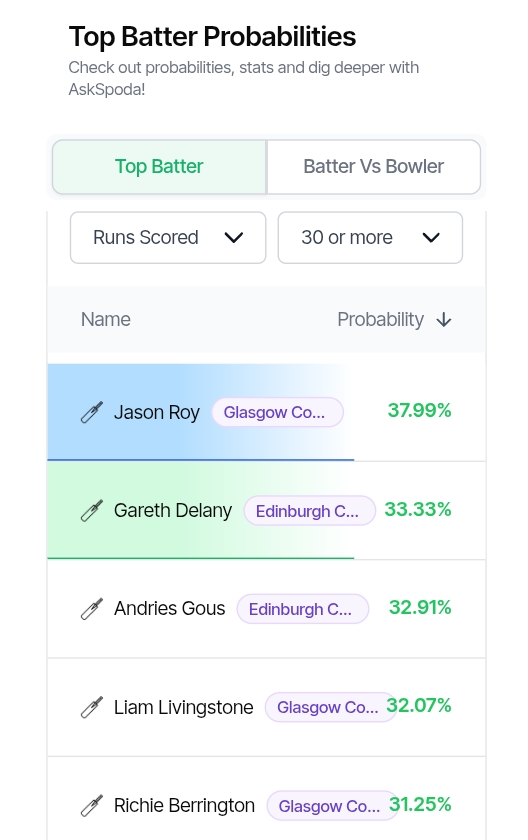
Roy sits at the top of the probability board because Glasgow gives him an unconditional green light to exploit field restrictions from ball one. When Roy survives the initial new-ball spell, his aggressive intent turns routine Powerplays into 30+ run launching pads.
The Blueprint: Plants his front leg to club full balls through extra cover or quickly rocks onto the back foot to flat-bat short deliveries over mid-on and deep mid-wicket.
Current Form & Analytics: Holding a franchise T20 career strike rate north of 140, Roy enters in commanding rhythm as Glasgow’s tournament anchor, having already amassed 174 runs across his previous European T20 outings.
Why Gareth Delany Has 33.33% Probability
Delany provides Edinburgh with high-leverage acceleration in the middle and late overs. Known for clearing the ropes at will, he enters games with an aggressive mindset designed to turn brief cameos into 30+ scores within 15 to 20 deliveries.
The Blueprint: Uses a clean, high-swinging arc to clear the front leg against both pace and spin, targeting straight down the ground and over cow corner against anything pitched in the slot.
Current Form & Analytics: A vital white-ball match-winner for Ireland, Delany strikes above 135 in T20 cricket, regularly cashing in when opponents miss their death-over yorker marks.
Why Andries Gous Has 32.91% Probability
Gous is the linchpin American talent in the Rockers’ top order. Whether opening or batting at number three, his balance of calculated strike rotation and boundary-hitting makes him a prime candidate to pass 30 runs.
The Blueprint: Plays the ball late directly under his eyes, punching through backward point against pace and dancing down the deck to loft spinners over extra cover.
Current Form & Analytics: Fresh off leading the United States’ historic 2024 T20 World Cup charge (averaging 30+ at a 142+ strike rate), Gous remains in sharp touch, previously compiling a fluent 40 off 28 balls against Glasgow earlier in the campaign.
Why Liam Livingstone Has 32.07% Probability
Livingstone offers unmatched ceiling and bat speed. Even when coming in during tricky middle-overs situations, his ability to target massive sixes down the ground means he can race past 30 runs before the opposition can set defensive fields.
The Blueprint: Generates immense hip rotation and torque from an open-chested stance, obliterating length balls over the leg side and taking down right-arm spin with sweeping blows over deep backward square.
Current Form & Analytics: Across 250+ global franchise T20s, Livingstone boasts a fearsome strike rate over 145, routinely turning 15-ball bursts into game-changing 30+ scores during overs 10 to 18.
Why Richie Berrington Has 31.25% Probability
Berrington is Glasgow’s situational anchor. If early wickets tumble to Edinburgh’s new-ball seamers, Berrington’s experience allows him to absorb pressure, construct an innings, and cruise past 30 through controlled, low-risk stroke play.
The Blueprint: Leans on classical footwork, executing wristy glances behind square and punchy drives through the cover gap to turn over strike before lifting the run rate late.
Current Form & Analytics: As Scotland’s most capped international run-scorer with over 2,000 T20I runs, Berrington converts starts into 30+ run totals in more than a third of his competitive T20 appearances.
Glasgow Cosmics vs Edinburgh Castle Rockers – Top Bowlers (2+ Wickets)
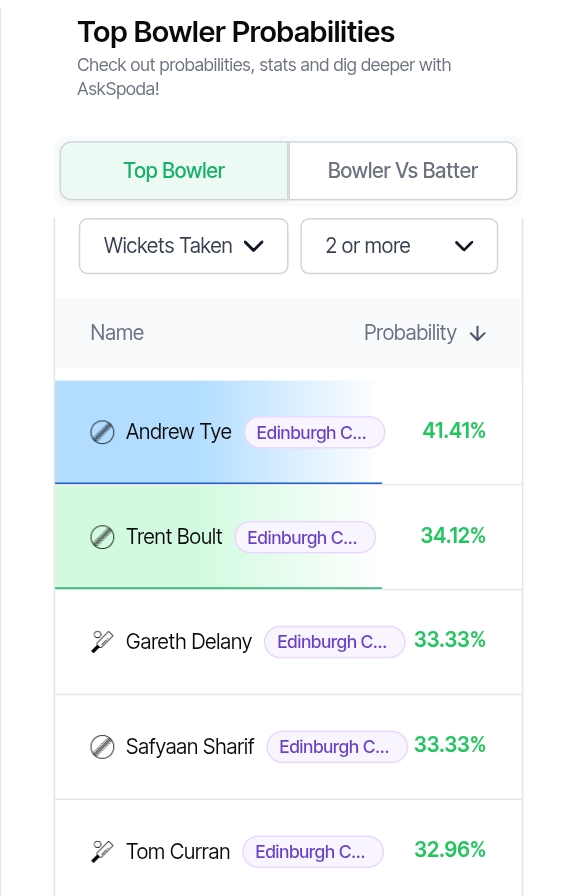
Why Andrew Tye Has 41.41% Probability
Tye tops Edinburgh’s wicket-taking board as franchise cricket’s premier death-overs trickster. When opposing batters throw caution to the wind in the final five overs, his mastery of off-speed pitching turns aggressive slogs into soft outfield catches.
The Blueprint: He utilizes his signature knuckleball alongside wide dipping yorkers, disrupting batters’ swing plane like an elite pitcher’s changeup to induce sliced toe-end mistimed hits.
Current Form & Analytics: Operating with a death-overs economy near 8.40, Tye has produced 2 or more wickets in over 40% of his competitive T20 outings, making him a perennial threat to grab wickets in clusters.
Why Trent Boult Has 34.12% Probability
Boult represents the global gold standard for early wicket-taking threat. With a brand-new white ball in hand, he creates immediate jeopardy for opening batters through sheer seam and late swing.
The Blueprint: He pitches right up into the driving channel from over the wicket, swinging the ball late into right-handers’ front pads or taking the outside edge to feed the slip cordon.
Current Form & Analytics: Entering this Scottish derby in lethal rhythm with 11 tournament wickets already in his bag, Boult strikes inside the Powerplay every 15 deliveries while maintaining an exceptional economy under 7.00.
Why Gareth Delany Has 33.33% Probability
Delany is Edinburgh’s tactical middle-overs weapon. Because opposing lineups often target his wrist-spin to push the run rate, his quick trajectory and subtle drift naturally bring frequent high-risk mistimed shots.
The Blueprint: Fires in a flatter, rapid leg-break paired with a skiddy slider that rushes onto the front pad, forcing hurried pulls and lofted swipes toward the deep boundary riders.
Current Form & Analytics: An international match-winner with Ireland, Delany strikes at an aggressive rate under 17 balls per wicket in T20s, converting middle-phase pressure into multi-wicket bursts in one out of every three matches.
Why Safyaan Sharif Has 33.33% Probability
Sharif is Scotland’s proven fast-medium workhorse. His ability to hit the pitch hard and extract seam movement under overcast conditions makes him a lethal middle- and death-overs enforcer.
The Blueprint: Pounds a nagging back-of-a-length channel right into the batters’ ribs before hunting the blockhole with tailing deliveries aimed at middle and off stump.
Current Form & Analytics: Boasting 87 T20I wickets for Scotland with an economy under 8, Sharif routinely bags 2+ wickets when operating in friendly home conditions where seam and natural variation play a decisive role.
Why Tom Curran Has 32.96% Probability
Curran is a specialist in closing out tight contests. Tasked with delivering high-pressure overs at the death, he thrives on outthinking power-hitters with rapid grip-and-turn variations.
The Blueprint: Changes his release point and pace effortlessly, relying on back-of-the-hand slower balls, cross-seam bouncers, and accurate tramline yorkers that leave hitters with zero room.
Current Form & Analytics: Curran is in electric form in the tournament, ripping through batting orders with figures of 4/20 against Belfast and 3/16 against Rotterdam, sustaining a lethal tournament strike rate of under 10 balls per wicket.
What is the Squad Strength of Glasgow Cosmics
The Cosmics have assembled a powerhouse lineup featuring proven international firepower, aiming to shake off recent inconsistent form and revive their tournament campaign.
Top Order & Leadership: Led by explosive Scotland batter George Munsey, the top order relies heavily on the dynamic Jason Roy, who has been in sparkling touch with 174 runs this tournament. Reliable wicketkeeper-batter Matthew Cross provides early stability and sharp glovework.
Finishing Power: The middle and lower order packs immense muscle with England superstar Liam Livingstone and all-rounder Moises Henriques. Alongside experienced middle-overs anchor Richie Berrington and dynamic hitter Michael Leask, Glasgow can rapidly clear boundaries at the death.
Bowling Strength: The seam attack is spearheaded by South African speedster Lungi Ngidi, who has impressed with 7 scalps, backed by US pacer Ali Khan and Dutch quick Paul van Meekeren. South African veteran Keshav Maharaj anchors the spin department with precision and suffocating economy.
What is the Squad Strength of Edinburgh Castle Rockers
The tournament front-runners boast an ultra-balanced squad that blends destructive power hitters with world-class swing and all-round depth.
Top Order & Leadership: Commanded by New Zealand maestro Mitchell Santner, the top order relies on the aggressive Ross Adair and USA standout Andries Gous, backed by the reliable strokeplay of Brandon McMullen.
Finishing Power: In-form all-rounder JJ Smuts has been in blistering touch, leading the charge with a 98-run masterclass, while England international Tom Curran delivers boundary-hitting stability alongside Santner in the late overs.
Bowling Strength: Legendary Kiwi pacer Trent Boult headlines the new-ball attack with his lethal swing, supported by Tom Curran’s variations (fresh off a 4-wicket haul) and Scotland seamer Safyaan Sharif. The spin department is anchored by Santner’s pinpoint left-arm orthodox control alongside Scotland’s experienced Mark Watt and Pakistan star Shadab Khan.
Final Verdict – Today Match Prediction
Glasgow Cosmics have the raw explosive potential to defeat anyone on their day, but Edinburgh Castle Rockers boast supreme team balance, bowling depth, and winning momentum. With Trent Boult and Mitchell Santner dictating terms with the ball, the Rockers enter this Scottish derby as firm favorites to take the victory.
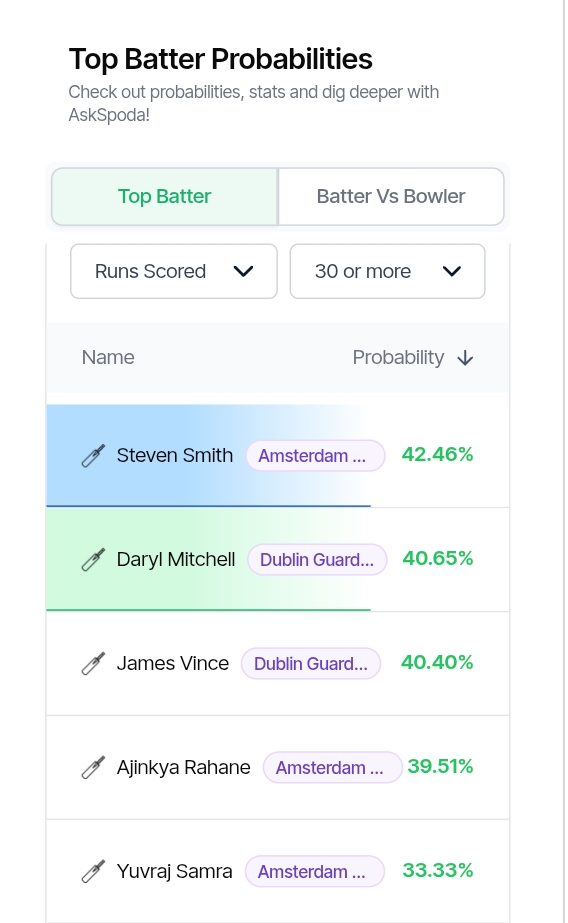
Amsterdam Flames vs Dublin Guardians – Top Batters to Watch (30+ Runs Probability)
Why Steven Smith Has 42.46% Probability
Smith sits at the very top of the board because his low-risk batting model is engineered to reach milestone scores. In modern 20-over cricket, where wild swinging frequently ends innings early, Smith’s ability to manipulate fields guarantees he sees enough deliveries to cross the 30-run mark.
The Blueprint: He shuffles across his stumps to align his eyes with the ball, effortlessly tucking deliveries behind square or driving pace through the infield with elite placement.
Current Form & Analytics: Smith converts starts at one of the highest rates in global cricket, crossing 30 runs in roughly 43% of his T20 innings with a dot-ball percentage kept below 32%.
Why Daryl Mitchell Has 40.65% Probability
Mitchell provides Dublin with elite middle-overs security. When the game slows down against spin, Mitchell takes charge by going down the ground with sheer reach and heavy power.
The Blueprint: He clears his front leg and utilizes a full swing through the line, targeting the straight boundary and long-on against both off-break and slow left-arm bowling.
Current Form & Analytics: Mitchell averages nearly 32 in modern T20 cricket, striking at 138+ and consistently absorbing early middle-order wickets to construct 30-plus counter-attacking knocks.
Why James Vince Has 40.40% Probability
Vince is Dublin’s primary scoring engine at the top of the order. If he navigates the first 10 balls of the match, his classical strokeplay allows him to accumulate runs rapidly without taking reckless risks.
The Blueprint: He stands tall and punches through cover on the up, leaning on effortless timing and balance rather than brute force.
Current Form & Analytics: Vince enters in scorching form after carrying Dublin’s lineup with a magnificent, unbeaten 95 off just 54 balls (5 fours, 6 sixes) in their previous game.
Why Ajinkya Rahane Has 39.51% Probability
Rahane brings classical timing and top-order calmness to Amsterdam’s lineup. He flourishes against hard new-ball pace, using the bowler’s speed to clear the infield effortlessly during the Powerplay.
The Blueprint: He holds his shape through the shot, relying on high-elbow cover drives and short-arm pulls rather than pre-meditated boundary slogging.
Current Form & Analytics: Across his franchise T20 career, Rahane boasts a steady strike rate of 125+ in the Powerplay while maintaining a sturdy foundation, passing 30 runs in over 38% of his outings.
Why Yuvraj Samra Has 33.33% Probability
Samra is Amsterdam’s explosive breakout prospect at the top. While aggressive intent naturally brings risk, his boundary-hitting capability means he can knock off a 30-run threshold in just 12 to 15 balls.
The Blueprint: A fluent left-hander who uses strong bottom-hand extension to muscle back-of-length deliveries over wide mid-wicket and launch full deliveries over cover.
Current Form & Analytics: Samra was in blistering touch in his last outing, blasting 73 runs off only 32 balls (7 fours, 5 sixes) at an eye-watering strike rate of 228.13.
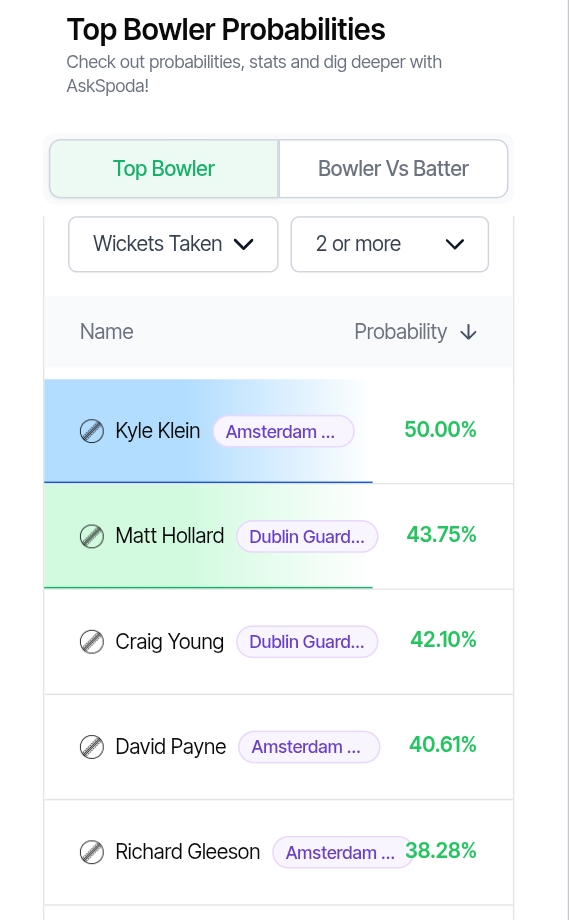
Amsterdam Flames vs Dublin Guardians – Top Bowlers (2+ Wickets)
Why Kyle Klein Has 50.00% Probability
Klein enters the September 5 matchup holding the highest probability on the board because Amsterdam relies on him as their frontline strike enforcer in both the Powerplay and middle overs. If opposing batters try to step out and muscle him, his natural bounce quickly turns attacking drives into soft dismissals.
The Blueprint: Towering deliverer who hits a nagging back-of-a-length channel. He cramps batters for room right around the rib cage, making horizontal-bat shots high-risk and inducing sliced mishits to backward point and mid-off.
Current Form & Analytics: Klein strikes on average every 13.5 deliveries in 2026 European T20 fixtures, sustaining a disciplined sub-7.50 economy rate while repeatedly producing multi-wicket breakthroughs.
Why Matt Hollard Has 43.75% Probability
Hollard is Dublin’s go-to breakthrough specialist, possessing the uncanny knack of striking in bunches right when the batting side looks to accelerate.
The Blueprint: He maintains an aggressive, skiddy stump-to-stump trajectory before surprising batters with sharp off-pace cutters that grip into the deck, turning aggressive lofted drives into straightforward catches at long-on and deep mid-wicket.
Current Form & Analytics: Hollard has been a proven wicket-taker throughout 2026, highlighted by back-to-back 3-wicket masterclasses against India (3/26 and 3/28) alongside a 2/29 outing against Glasgow Cosmics in ETPL action.
Why Craig Young Has 42.10% Probability
Young brings seasoned international pedigree to the Guardians’ new-ball attack, consistently testing top orders in the opening overs before returning to execute yorkers at the death.
The Blueprint: Attacks a fuller channel outside off-stump, generating late shape away from left-handers and nipping back into right-handers to force hesitant forward defenses, leading to edges behind or LBW shouts.
Current Form & Analytics: Operating with an elite career T20 strike rate under 16 balls per wicket, Young has picked up 2+ wickets in over 40% of his career T20 spells, excelling particularly during cool conditions that aid seam movement.
Why David Payne Has 40.61% Probability
Payne is one of franchise cricket’s most craftiest left-arm pacers. His left-arm angle instantly breaks batting rhythm and provides Amsterdam with supreme death-overs security.
The Blueprint: Changes angles expertly from over and around the wicket, targeting the wide tramline with subtle variations in pace while unleashing disguised leg-cutter bouncers that rush through high.
Current Form & Analytics: A seasoned global circuit campaigner across the Blast and IPL, Payne concedes less than 7.4 runs per over across his recent franchise T20 appearances while routinely closing out matches with back-to-back scalps in overs 18 and 20.
Why Richard Gleeson Has 38.28% Probability
Gleeson provides raw, unadulterated velocity. When opposing batters attempt to launch in the closing overs, Gleeson’s pure 90+ mph heat shrinks their decision-making window down to a split second.
The Blueprint: He sprints in from a bustling, dynamic run-up and unleashes searing, spearing yorkers right at the base of the off and middle stumps, leaving batters with minimal margin for bat speed.
Current Form & Analytics: Gleeson strikes inside the Powerplay every 14.8 deliveries, and his knack for cleaning up tails at the death cements his high baseline for taking 2 or more wickets in 4-over bursts.
What is the Squad Strength of Amsterdam Flames
The Flames have built their lineup around a high-profile Australian-Dutch core, combining elite international pedigree with proven local Netherlands stars.
Top Order & Leadership: Led by Australian power-hitter Mitchell Marsh, the batting relies heavily on former Australian captain Steve Smith to anchor innings with composure. Youngster Yuvraj Samra and Dutch international Max O’Dowd provide steady support to set a platform.
Finishing Power: Explosive finisher Tim David provides raw lower-order muscle and boundary-clearing ability. He is supported by Dutch national captain Scott Edwards behind the stumps and all-rounder Bas de Leede, who enters as their most in-form batter after tallying 82 runs in the early stages.
Bowling Strength: The seam unit is led by English left-arm quick David Payne and pacer Richard Gleeson, backed by in-form seamer Kyle Klein. In the spin department, off-spinner Aryan Dutt and Kiwi all-rounder Michael Bracewell provide tight lines and middle-overs control.
What is the Squad Strength of Dublin Guardians
The Guardians are chasing their first breakthrough win of the campaign, relying heavily on veteran tactical nous and elite international ball-strikers to reset their season.
Top Order & Leadership: Commanded by master tactician Ravichandran Ashwin, the Guardians lean heavily on veteran opener James Vince, who has been in supreme touch with a fluent 95-run outing at the top. Dynamic talent Noah Croes and Harry Tector form the middle-order spine.
Finishing Power: Heavy hitter Daryl Mitchell and all-rounder George Dockrell anchor the closing overs. Alongside Vijay Shankar, they bring proven franchise poise to clear ropes in the final five overs.
Bowling Strength: Left-arm express quick Joshua Little leads the pace battery with his lethal early swing, supported by seamer Matthew Hollard. For spin, captain Ashwin dictates the tempo through mystery and relentless accuracy, joined by US left-arm spinner Harmeet Singh to choke runs in the middle phase.
Final Verdict – Today Match Prediction
Dublin Guardians possess immense individual firepower on paper, but Amsterdam Flames hold the tactical edge in balanced team form and death hitting. With Tim David and Bas de Leede firing in tandem, Amsterdam Flames enter as favorites to snatch another key victory.
FAQs
Who is the top bowler to watch in the Amsterdam Flames vs Dublin Guardians?
According to the SpodaAI data, Kyle Klein is the top bowler to watch.
What is the batting first score prediction in Amsterdam Flames vs Dublin Guardians?
According to the SpodaAI data, there will be a 109-150 batting first score.
Who is the top batter to watch in the Amsterdam Flames vs Dublin Guardians?
According to the SpodaAI data, Steven Smith is the top batter to watch.
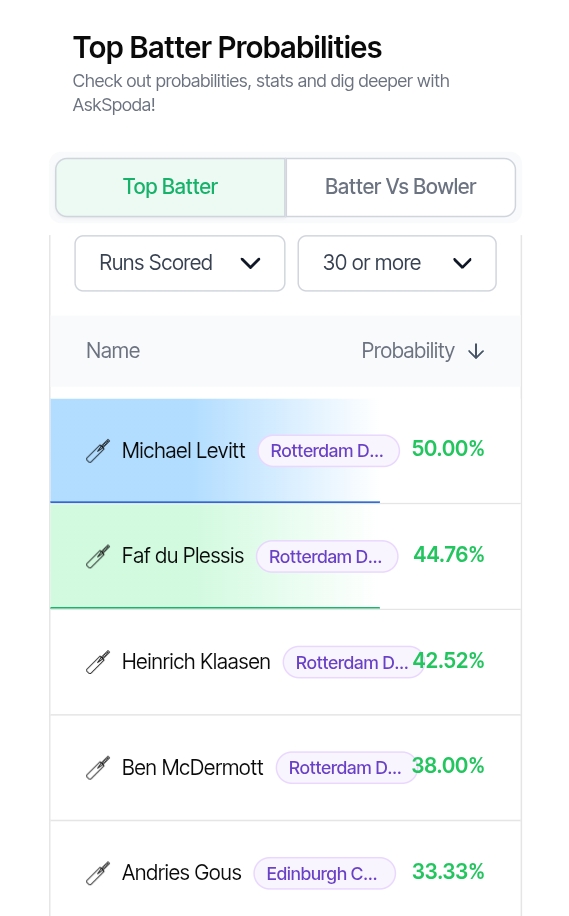
Levitt tops the probability chart because his sole remit is to exploit field restrictions during the opening six overs. He does not waste time getting his eye in; he attacks early, and if he survives the initial swing burst, a 30+ score is practically guaranteed.
The Blueprint: He utilizes an explosive, tall trigger movement that lets him drop his hands quickly through the line of the ball, routinely hammering back-of-length pace through covers or dragging it over deep mid-wicket.
Current Form & Analytics: A destructive powerplay bat for the Netherlands with a T20I career strike rate over 145, Levitt consistently generates high boundary percentages, giving him an even 50% likelihood to cross the 30-run mark before fielding spreads out.
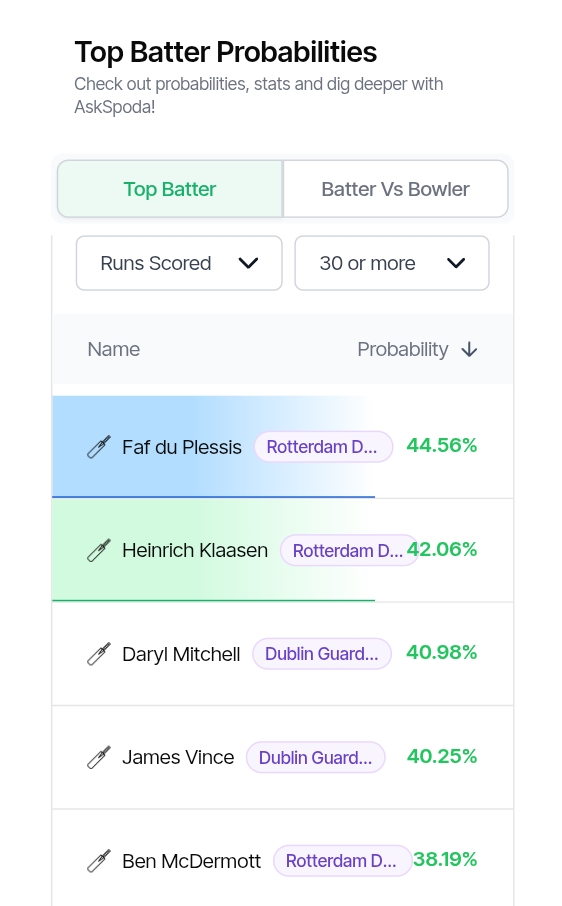
Why Faf du Plessis has 44.76% Probability
Rotterdam’s skipper remains the ultimate benchmark for modern anchor-to-accelerator play. When du Plessis gets past double digits, his boundary access multiplies rapidly without escalating risk.
The Blueprint: Leaning on quick footwork and elite upper-body leverage, du Plessis opens the off-side with clean inside-out lofted drives over extra cover, blending classical stroke-play with scoop ramps against back-of-the-hand slower deliveries.
Current Form & Analytics: Coming fresh off a match-winning 79-run masterclass in the tournament, Faf has already racked up 170+ tournament runs, demonstrating that his game awareness and phase pacing are functioning at peak franchise-cricket levels.
Why Heinrich Klaasen has 42.52% Probability
Widely regarded as the world’s most destructive hitter against spin bowling, Klaasen represents pure high-leverage firepower. Entering in the middle overs, he faces fewer deliveries than top-order batters, which slightly caps his 30+ volume probability at 42.52% despite his sheer destructive ceiling.
The Blueprint: Klaasen relies on a rock-solid base and lightning-fast hand speed, dispatching deliveries from middle stump over deep mid-wicket and long-on without having to dance down the pitch.
Current Form & Analytics: In elite T20 leagues, Klaasen maintains an eye-watering strike rate above 160 against spin, routinely converting 15–20 delivery stays into explosive 35-to-40-run innings that dismantle opposition bowling plans.
Why Ben McDermott has 38.00% Probability
McDermott is an aggressive ball-striker who can turn games rapidly through the middle overs. Because he typically operates in dynamic positions where boundaries are demanded immediately from ball one, his boom-or-bust risk profile puts his 30+ probability at 38.00%.
The Blueprint: McDermott thrives against short-pitched bowling, transferring his weight swiftly onto the back foot to execute punishing horizontal-bat pulls and swivels into square boundaries.
Current Form & Analytics: A proven veteran of top T20 leagues, McDermott’s strike rate consistently sits north of 135 in short-format cricket, meaning when he navigates the first 10 balls, his conversion into a 30+ score jumps significantly.
Why Andries Gous has 33.33% Probability
American cricket fans know Andries Gous as the engine of Team USA’s historic top order. Facing Rotterdam’s express pace attack led by Anrich Nortje, Gous carries a 33.33% probability to hit 30+ runs, tasking him to absorb early heat before opening his shoulders.
The Blueprint: Gous blends classical back-foot defense with modern pickup sweeps and aerial ramps against both high-velocity seamers and turning orthodox spin.
Current Form & Analytics: The historic centurion from Major League Cricket (where he blasted an iconic 132 off 51 balls) recently compiled a gritty 40 off 28 deliveries against Glasgow, proving he can match Rotterdam’s heavy artillery stroke-for-stroke.
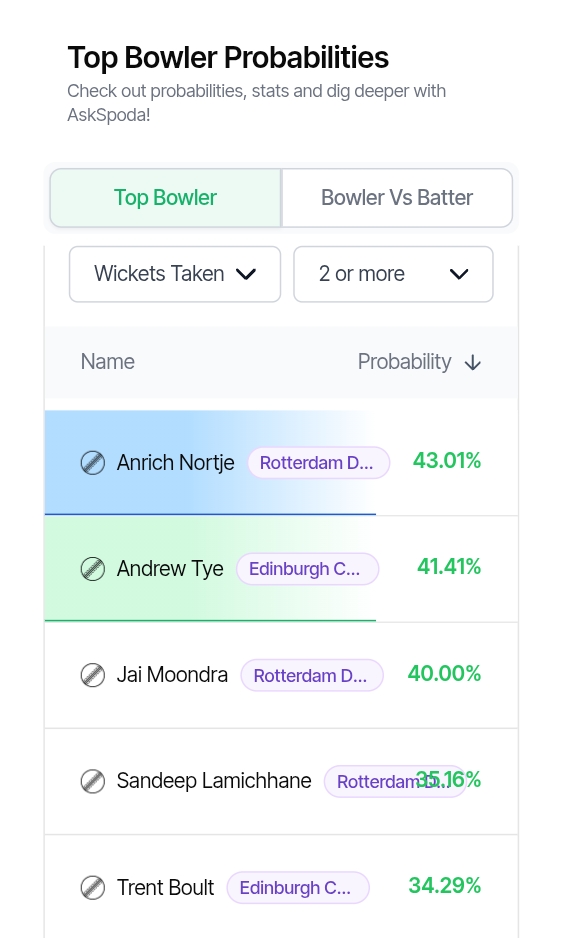
Rotterdam Dockers vs Edinburgh Castle Rockers – Top Bowlers (2+ Wickets)
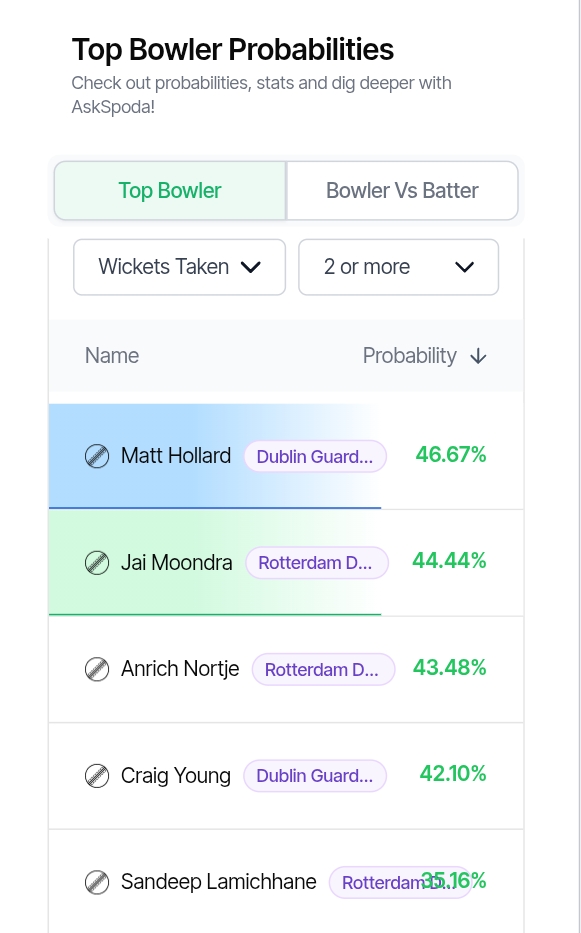
Why Anrich Nortje Has 43.01% Probability
Nortje is the definition of pure, unadulterated heat. Operating north of 90 mph, he gives batters zero recovery time, relentlessly attacking the stumps and targeting the throat during both the Powerplay and late death overs.
The Blueprint: He relies on a rapid skiddy trajectory and steep bounce from a hard length, regularly jamming batters for room and producing rushed top-edges or broken stumps.
Current Form & Analytics: Across his recent franchise and international campaigns, Nortje strikes every 14.2 balls in T20s, averaging 1.6 wickets per 4-over spell while conceding under 7.8 runs per over.
Why Andrew Tye Has 41.41% Probability
Tye is one of franchise cricket’s premier death-over tricksters. When batters try to swing for the fences in the closing overs, Tye’s deep bag of deceptive off-speed deliveries turns desperate hitting into easy catches.
The Blueprint: His patented knuckleball and wide yorkers disrupt timing like a baseball pitcher’s changeup, inducing mis-hits straight to long-on and deep mid-wicket.
Current Form & Analytics: A certified multiple-wicket specialist, Tye has claimed 2+ wickets in nearly 40% of his T20 appearances over the past year, boasting a death-overs economy rate of 8.40.
Why Jai Moondra Has 40.00% Probability
Moondra has emerged as Europe’s hottest breakout left-arm quick. He bursts through batting orders in the opening overs, creating immediate chaos with genuine swing and sharp angles.
The Blueprint: Moondra pitches full from over the wicket, angling the ball across right-handers before snapping back late into pads to draw LBW and bowled dismissals.
Current Form & Analytics: Fresh off a breakthrough series where he bagged 5 wickets in 2 T20Is against powerhouse opposition (including 3/32 in Belfast), he strikes in the Powerplay at an elite strike rate of just 9.6 balls per wicket.
Why Sandeep Lamichhane Has 35.16% Probability
Lamichhane thrives on bamboozling middle orders. In a format where batters feel pressured to target spin, his rapid arm action and hidden variations create instant wicket-taking windows.
The Blueprint: He attacks the stumps on a flatter trajectory, mixing conventional leg-breaks with a disguised googly that traps sweeping batters right in front.
Current Form & Analytics: Holding a career T20 strike rate of under 16 balls per dismissal, Lamichhane routinely breaks partnerships, having registered 2+ wickets in 4 of his last 10 competitive franchise fixtures.
Why Trent Boult Has 34.29% Probability
Boult is a global benchmark for left-arm swing bowling. When he has a brand-new ball in hand, top-order batters face one of the most lethal first-over assignments in modern cricket.
The Blueprint: He pitches the ball right up to swing late into the right-hander’s front pad, forcing tentative pushes outside off-stump to feed the slips and wicketkeeper.
Current Form & Analytics: Boult averages nearly a wicket every Powerplay spell (economy 6.90 in overs 1–6), combining his vintage early-burst strike power with deadly toe-crushing yorkers at the death.
What is the Squad Strength of Rotterdam Dockers
The Dutch franchise has paired seasoned global superstars with top-tier Associate stalwarts, building a lineup packed with elite hitting and express pace.
Top Order & Leadership: Led by captain Faf du Plessis, the batting is spearheaded by his fluent strokeplay alongside the hard-hitting Netherlands opener Michael Levitt and Vikramjit Singh. Du Plessis recently anchored the side with a classy 79 runs, setting a rock-solid foundation at the top.
Finishing Power: Heinrich Klaasen and Donovan Ferreira provide unmatched firepower through the middle and death overs, backed by veteran all-rounder David Wiese to close out games in devastating fashion.
Bowling Strength: The pace attack is steered by South African speedster Anrich Nortje and Netherlands death-overs specialist Logan van Beek. For spin, they rely heavily on veteran left-arm orthodox Roelof van der Merwe—who recently bagged two crucial scalps—alongside the mystery wrist-spin of Sandeep Lamichhane.
What is the Squad Strength of Edinburgh Castle Rockers
The tournament front-runners boast an ultra-balanced squad that blends destructive power hitters with world-class swing and all-round depth.
Top Order & Leadership: Commanded by New Zealand maestro Mitchell Santner, the top order relies on the aggressive Ross Adair and USA standout Andries Gous, backed by the reliable strokeplay of Brandon McMullen.
Finishing Power: In-form all-rounder JJ Smuts has been in blistering touch, leading the charge with a 98-run masterclass, while England international Tom Curran delivers boundary-hitting stability alongside Santner in the late overs.
Bowling Strength: Legendary Kiwi pacer Trent Boult headlines the new-ball attack with his lethal swing, supported by Tom Curran’s variations (fresh off a 4-wicket haul) and Scotland seamer Safyaan Sharif. The spin department is anchored by Santner’s pinpoint left-arm orthodox control alongside Scotland’s experienced Mark Watt and Pakistan star Shadab Khan.
Final Verdict – Today Match Prediction
This is a heavyweight clash between the tournament’s top two sides, each locked on 7 points. While Rotterdam Dockers bring sheer boundary-hitting muscle with du Plessis and Klaasen, Edinburgh Castle Rockers hold the slight edge. The Rockers’ deeper all-round contingent, led by in-form Smuts, Curran, and Boult’s powerplay strike ability, makes them best equipped to seize key match moments.
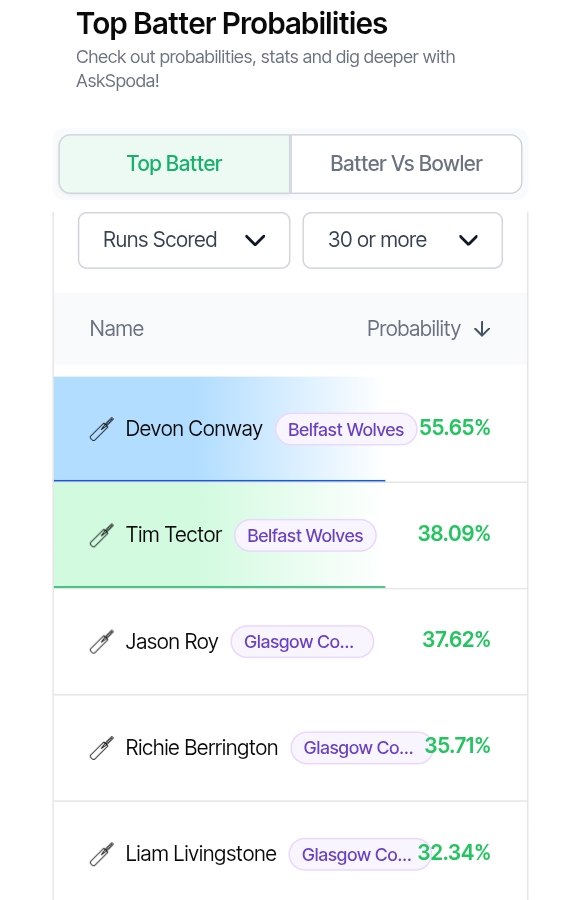
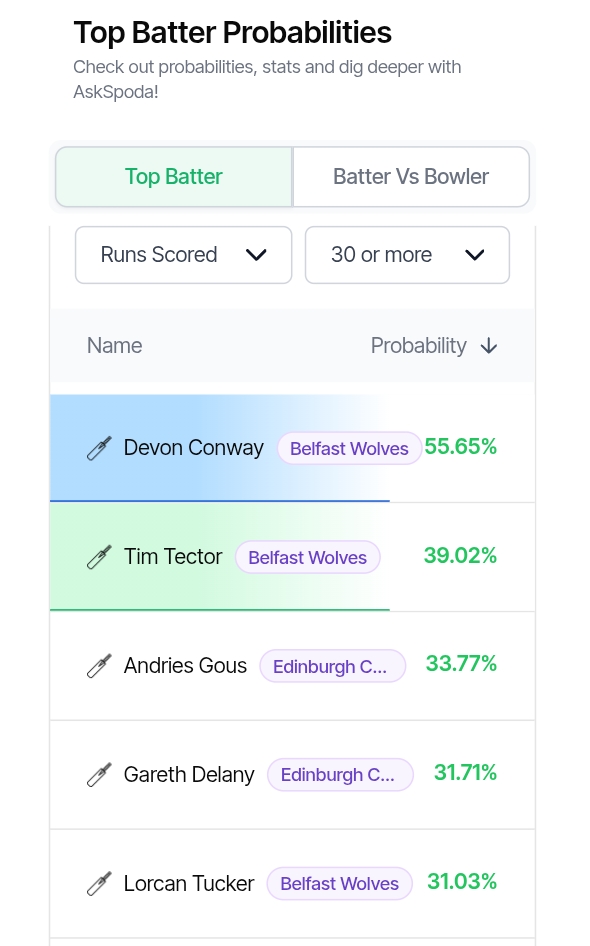
Conway gives Belfast an elite, low-risk scoring engine who can anchor the entire innings or accelerate on demand. At over 55%, his probability leads the field because he minimizes dot balls and protects his wicket during early swing phases.
The Blueprint: Uses soft hands to work fielders through cover point, utilizing supple wrists against length pace before dancing down to take on spin over extra cover.
Current Form & Analytics: Conway carries a career T20 international average above 39.00 and routinely faces 25+ deliveries per innings, making his path to the 30-run threshold the safest across both squads.
Why Tim Tector has 38.09% Probability
The young Irish prodigy plays with total fearlessness in the top order, tasked with maximizing Belfast’s powerplay overs alongside proven veterans.
The Blueprint: Backs his hand-eye coordination with high back-lift mechanics, punching through the line over mid-off and executing aggressive flat-bat pulls against short deliveries.
Current Form & Analytics: Tector’s high boundary percentage early in innings boosts his conversion rate quickly; once he navigates the first 10 balls, his trajectory consistently points toward 30+ contributions.
Why Jason Roy has 37.62% Probability
Roy brings ruthless white-ball pedigree to Glasgow’s opening slot, capable of settling the powerplay contest single-handedly if he survives the initial three overs.
The Blueprint: Clears the front leg and attacks on the up through extra cover and deep mid-wicket, forcing pacers to alter their lengths immediately.
Current Form & Analytics: Roy tops Glasgow’s run-scoring charts in the tournament with 82 runs. When his timing is dialled in, he frequently blows past the 30-run mark inside the first six overs alone.
Why Richie Berrington has 35.71% Probability
Berrington functions as Glasgow’s tactical sheet-anchor in the middle overs, expertly steadying collapses or kicking on against the spinners.
The Blueprint: Stands tall in his crease to drive with a straight bat down the ground, using his reach to neutralize spin before unleashing standard horizontal-bat pulls off seamers.
Current Form & Analytics: Boasting more than 100 T20 appearances for Scotland with an average pushing near 30, Berrington’s proven situational awareness makes him a reliable middle-order pick for 30+ runs.
Why Liam Livingstone has 32.34% Probability
Livingstone provides explosive upside at the backend, bringing unmatched raw bat speed capable of shifting game momentum in a 10-ball span.
The Blueprint: Targets the straight boundary and deep cow corner, generating torque from a solid hip rotation to send back-of-a-length deliveries over the ropes.
Current Form & Analytics: Fresh off a blitzing 39-ball 54 earlier in the tournament, Livingstone scores in explosive bursts; if Glasgow gets a stable top-order foundation, his likelihood of hitting a rapid 30 or more runs rises rapidly.
Amsterdam Flames vs Glasgow Cosmics – Top Bowlers (2+ Wickets)
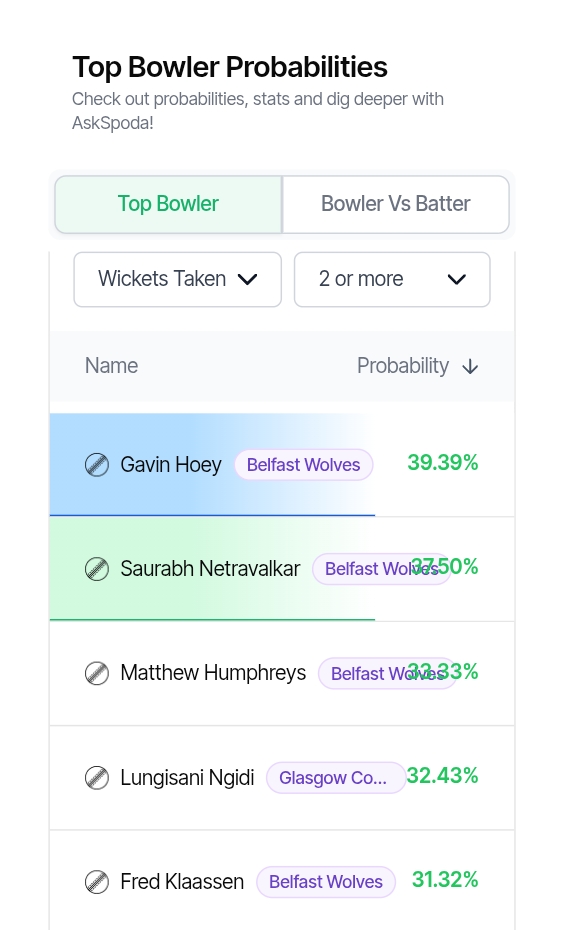
Why Gavin Hoey has 39.39% Probability
Hoey enters as Belfast’s top wicket-taking bet because middle-order batters are forced to take high-risk routes against his leg-spin variations.
The Blueprint: Loops the ball above the eye-line to draw mistimed lofted shots toward long-on and deep mid-wicket, mixing in a fast, skiddy googly to target the stumps directly.
Current Form & Analytics: Across domestic and European franchise T20s, Hoey maintains a lethal strike rate near 15.00 with career-best T20 figures of 4 for 25, giving him nearly a 40% shot at claiming multiple scalps when batters attempt to accelerate through the middle overs.
Why Saurabh Netravalkar has 37.50% Probability
The USA national team talisman and Major League Cricket star brings world-renowned precision to the Belfast Wolves’ bowling unit. American cricket fans will recognize his knack for striking in high-leverage powerplay and death-overs situations.
The Blueprint: Uses an angled approach from over the wicket to naturally carry the ball across right-handers, then nails tight yorkers on the fourth-stump line to produce bowled and LBW dismissals.
Current Form & Analytics: Coming off dominant multi-wicket spells on the international stage, Netravalkar averages under 22 in T20 cricket with an economy under 7.50. His dual deployment in overs 1–3 and 18–20 significantly increases his multi-wicket upside.
Why Matthew Humphreys has 33.33% Probability
Humphreys provides tactical spin control from the other end, tightening the squeeze on batters alongside Hoey to induce forced mistakes.
The Blueprint: Employs classic left-arm orthodox drift with subtle changes of pace, firing a flatter delivery into the pads when batters try to make room or charge down the track.
Current Form & Analytics: With 66 career T20 wickets and best bowling figures of 5 for 13, Humphreys’ knack for building dot-ball pressure regularly results in wickets tumbling in rapid clusters.
Why Lungisani Ngidi has 32.43% Probability
Ngidi spearheads the Glasgow Cosmics’ pace attack and serves as their primary weapon for hunting breakthroughs against Belfast’s stacked top order.
The Blueprint: Hits the pitch hard on a back-of-a-length corridor to produce steep bounce, finishing his spells with deceptive knuckleballs that drop just short of full lengths.
Current Form & Analytics: Ngidi leads the Cosmics’ bowling department with 6 wickets in the tournament, highlighted by a match-winning 4 for 21 against Dublin. If he removes an opener early, his chances of a 2+ wicket return skyrocket.
Why Fred Klaassen has 31.32% Probability
Klaassen provides the Wolves with a reliable left-arm new-ball swing, tailor-made to exploit typical Hague conditions.
The Blueprint: Pitches full to generate late tail back into the pads of right-handers, looking to trap opening bats in front during the first two overs of the powerplay.
Current Form & Analytics: A proven veteran on the Dutch circuit with extensive white-ball experience, Klaassen strikes consistently with the brand-new ball, giving him a solid 31.32% probability of picking up a brace of wickets.
What is the Squad Strength of Glasgow Cosmics
The Cosmics have blended a battle-hardened Scottish spine with explosive global stars to create a dangerous, well-balanced T20 outfit.
Top Order & Leadership: Led by Scotland standout George Munsey, the top order gets early firepower from aggressive English opener Jason Roy, who leads the team’s run tally this tournament. Veteran Richie Berrington provides steady middle-order balance, capable of dropping anchor or accelerating when required.
Finishing Power: English power-hitter Liam Livingstone leads the lower-order fireworks with match-winning boundary hitting alongside Scottish finisher Michael Leask. Wicketkeeper-batter Matthew Cross adds depth and steady late-overs accumulation to round out the batting.
Bowling Strength: The pace attack is spearheaded by South African strike bowler Lungi Ngidi and Scottish left-arm quick Brad Currie, who consistently creates early breakthroughs. For spin, world-class South African left-arm spinner Keshav Maharaj locks down the middle overs alongside Livingstone’s handy variations.
What is the Squad Strength of Belfast Wolves
The Wolves boast one of the most dynamic rosters in the league, combining elite multi-nation franchise heavyweights with proven Irish match-winners.
Top Order & Leadership: Led by Aussie superstar Glenn Maxwell, the top order features explosive firepower with Ireland icon Paul Stirling and Kiwi top-order accumulator Devon Conway. Wicketkeeper Lorcan Tucker and young talent Tim Tector offer steady support to set dominant powerplay totals.
Finishing Power: Maxwell himself serves as one of the game’s ultimate death-overs destroyers. He is backed by South African powerhouse David Miller and New Zealand middle-order weapon Mark Chapman, making their finish arguably the most destructive in the competition.
Bowling Strength: The seam unit is led by English death-overs specialist Chris Jordan, Irish strike all-rounder Mark Adair, and Dutch left-arm pacer Fred Klaassen. In the spin and variation department, they count on young left-arm spinner Matthew Humphreys and the control of USA seamer Saurabh Netravalkar.
Glasgow Cosmics vs Belfast Wolves: Top Fantasy Picks
Top 3 Batters to Watch
Glenn Maxwell (Belfast Wolves): Maxwell is the premier match-winner in this lineup, renowned for turning games inside 15–20 deliveries. With an explosive career strike rate of 155.24 and over 10,000 T20 runs worldwide, his ability to target spin in overs 7–15 will dictate Belfast’s acceleration phase.
Jason Roy (Glasgow Cosmics): Operating as the aggressive engine at the top of the order, Roy sets the tone during powerplays. Backed by nearly 10,000 career runs, he enters as Glasgow’s primary run-scorer in the competition (82 runs), punishing width and clearing infield rings early.
Tim Tector (Belfast Wolves): An aggressive rising talent from Ireland, Tector combines a strike rate of 150.66 with a solid 31.88 average. His calculated boundary hitting gives Belfast insurance against early wickets while maintaining optimal momentum.
Top 3 Bowlers to Watch
Chris Jordan (Belfast Wolves): With 413 career T20 dismissals, Jordan serves as Belfast’s defensive lock at the death. His ability to hit wide yorkers and change-up cutters under pressure limits late damage against power hitters like Liam Livingstone.
Bradley Currie (Glasgow Cosmics): Currie is Glasgow’s most clinical new-ball threat, boasting a miserly 7.03 economy and an elite 18.17 bowling average. His left-arm angle across right-handed batters creates early lbw and caught-behind opportunities in the powerplay.
Mark Adair (Belfast Wolves): A proven workhorse with 208 T20 wickets and a 7.68 economy, Adair offers tactical flexibility across all three phases. He regularly breaks opening stands and provides tight containment in high-leverage middle overs.
Final Verdict – Today Match Prediction
This is a clash of bowling precision versus unbridled batting firepower. While Glasgow Cosmics possess a disciplined, wicket-taking bowling unit in Lungi Ngidi and Keshav Maharaj, the Belfast Wolves hold unmatched depth and boundary potential through Maxwell, Conway, and Miller. If the Cosmics do not strike repeatedly in the powerplay, the Belfast Wolves carry the firepower to out-bat them and claim the victory.
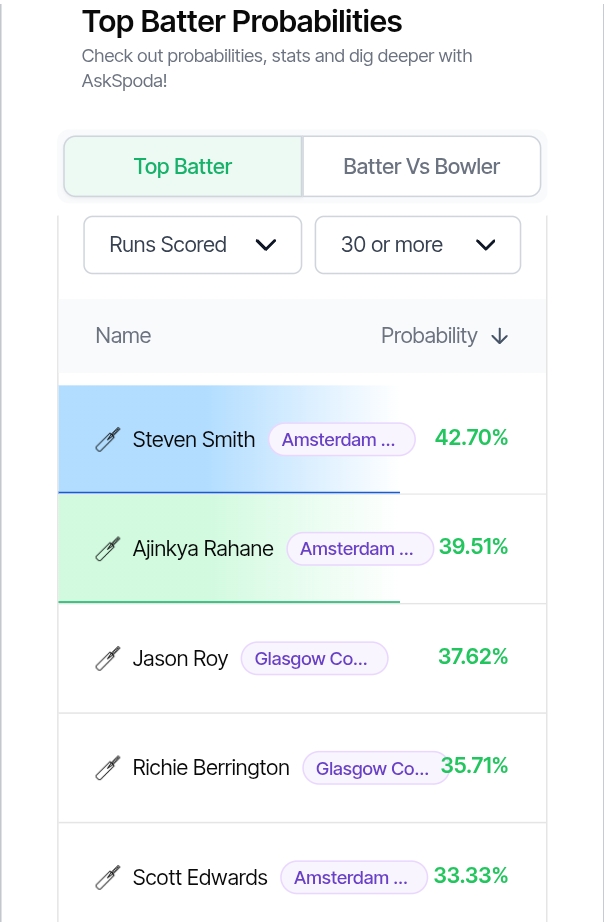
Smith provides the Amsterdam Flames with their most dependable anchor, controlling the innings while big hitters like Tim David capitalize around him. If Smith handles the opening seam variations from Lungi Ngidi, his probability of going past 30 runs is the highest on the board.
The Blueprint: Uses his trademark trigger movement across off-stump to access the leg side while manipulating point and third-man gaps with deft wristwork against spin.
Current Form & Analytics: Entering as the Flames’ primary stabilizing force with a career T20 average of 32.96, Smith operates at an optimal strike-rotation rate in the 7–15 over period, rarely conceding his wicket cheaply.
Why Ajinkya Rahane has 39.51% Probability
Rahane brings international poise and structured strokeplay to Amsterdam’s top order, offering the perfect counterweight to aggressive white-ball pitching.
The Blueprint: Plays strictly inside the line on swinging tracks, using high-elbow punches through the cover region and back-foot check-drives against back-of-a-length pace.
Current Form & Analytics: Maintaining a solid T20 average over 30, Rahane thrives against defensive field layouts in the powerplay, giving him a near 40% probability to convert early starts into 30+ totals.
Why Jason Roy has 37.62% Probability
Roy is the ultimate high-variance, maximum-intent top-order bat who can dismantle an attack inside the first 20 deliveries.
The Blueprint: Clears the front leg early to unleash brutal horizontal-bat pulls through mid-wicket, combined with dominant lofted drives over long-on against fuller lengths.
Current Form & Analytics: Leads the Glasgow Cosmics’ run charts in the tournament with 82 runs. When his boundary count clicks early, he frequently surges past the 30-run threshold within the initial powerplay phase alone.
Why Richie Berrington has 35.71% Probability
Berrington acts as the veteran backbone of the Cosmics’ middle order, tasked with stabilizing collapses or launching after a solid start.
The Blueprint: Relies on a strong base to work straight down the ground, using his reach against slow left-armers and short-ball execution against hard lengths.
Current Form & Analytics: Holds deep experience in Dutch and Scottish conditions, making his baseline floor high when entering during middle-over squeeze phases.
Why Scott Edwards has 33.33% Probability
Taking over captaincy duties and leading from behind the stumps, Edwards is Amsterdam’s rescue specialist whenever the top order stumbles.
The Blueprint: Employs an array of sweeps and reverse sweeps to disrupt spinner field placements, forcing fielders out of the circle to create easy boundary lanes.
Current Form & Analytics: Coming in with consistent contributions across international duties—including a recent 67 off 85 balls and multiple 50+ scores in 2026 ICC outings—his 33.33% probability offers sneaky value given his high balls-per-dismissal rate.
Amsterdam Flames vs Glasgow Cosmics – Top Bowlers (2+ Wickets)
Why Kyle Klein has 100.00% Probability
Klein is the strike spearhead for the Amsterdam Flames, leading the team’s tournament charts and creating immediate pressure with his natural height and hit-the-deck style. When he hits his mark, top-order batters struggle to find clean elevation.
The Blueprint: Uses his tall frame to pound an uncomfortable back-of-a-length, cramping right-handers and generating steep bounce that invites mistimed pull shots and slips catches.
Current Form & Analytics: He leads Amsterdam’s wicket column in the tournament, highlighted by a match-shaping 3 for 34 spell against the Rotterdam Dockers where he tore through the top order in the powerplay.
Why David Payne has 40.61% Probability
Payne brings elite left-arm variety and seasoned white-ball experience to the Flames’ new-ball and death-overs setup. If he catches early swing in Hague conditions, he regularly strikes in clusters.
The Blueprint: Attacks the stumps in the opening powerplay with sharp late inswing to right-handers, then switches to wide back-of-the-hand slower balls to break timing at the death.
Current Form & Analytics: Operating with an economy rate consistently under 8.00 in European circuit cricket, his heavy strike rate in overs 1–4 and 18–20 makes him a strong bet for multiple breakthroughs.
Why Richard Gleeson has 38.58% Probability
Gleeson provides raw, hurried pace that can catch top-order batters off-guard on European drop-in surfaces.
The Blueprint: Runs in hard with a skiddy trajectory, attacking the top of off-stump and utilizing a searing back-of-length delivery that forces rushed decisions.
Current Form & Analytics: Possessing a sub-18 career T20 bowling strike rate, Gleeson strikes in nearly two out of every three completed four-over quotas, giving him a nearly 39% shot at nabbing 2 or more wickets.
Why Lungisani Ngidi has 32.43% Probability
Ngidi is Glasgow’s undisputed premier strike option, trusted by captain George Munsey to break partnerships at critical junctures.
The Blueprint: Mixes heavy hit-the-deck deliveries with a dipping knuckle-ball slower variation that holds up in the pitch to produce mistimed outfield catches.
Current Form & Analytics: He leads Glasgow Cosmics’ wicket-taking tally with 6 scalps in the competition, including a tournament-best 4 for 21 against Dublin, cementing his status as their most lethal wicket option.
Why Bradley Currie has 27.78% Probability
Currie acts as Glasgow’s tactical swing bowler up front, offering pinpoint control with the new ball.
The Blueprint: Targets full lengths on a fourth-stump corridor, using his left-arm angle to lure outside edges through the cordon before slipping in a deceptive change of pace.
Current Form & Analytics: An international specialist for Scotland with a low career T20 economy rate, his threat relies entirely on early swing conditions; if Sportpark Westvliet offers morning moisture, his probability spikes considerably.
What is the Squad Strength of Amsterdam Flames
The Flames have built their lineup around a high-profile Australian-Dutch core, combining elite international pedigree with proven local Netherlands stars.
Top Order & Leadership: Led by Australian power-hitter Mitchell Marsh, the batting relies heavily on former Australian captain Steve Smith to anchor innings with composure. Youngster Yuvraj Samra and Dutch international Max O’Dowd provide steady support to set a platform.
Finishing Power: Explosive finisher Tim David provides raw lower-order muscle and boundary-clearing ability. He is supported by Dutch national captain Scott Edwards behind the stumps and all-rounder Bas de Leede, who enters as their most in-form batter after tallying 82 runs in the early stages.
Bowling Strength: The seam unit is led by English left-arm quick David Payne and pacer Richard Gleeson, backed by in-form seamer Kyle Klein. In the spin department, off-spinner Aryan Dutt and Kiwi all-rounder Michael Bracewell provide tight lines and middle-overs control.
What is the Squad Strength of Glasgow Cosmics
Coached by Matthew Hayden, the Cosmics rely on a blend of experienced Scottish stalwarts and destructive global T20 match-winners.
Top Order & Leadership: Captained by Scotland standout George Munsey, the top order is headlined by destructive English opener Jason Roy, who leads their batting charts with 82 runs. Scotland veteran Richie Berrington adds vital stability and previously led them to victory with a composed half-century.
Finishing Power: English star Liam Livingstone brings immense hitting ability to the death overs, fresh off a 39-ball 54. Alongside him, Scottish finisher Michael Leask and keeper Matthew Cross offer handy firepower to finish innings quickly.
Bowling Strength: South African strike bowler Lungi Ngidi headlines the pace attack with 6 wickets this tournament, aided by Scottish left-armer Brad Currie. For spin, South African international Keshav Maharaj offers world-class economy, complemented by Livingstone’s dual-spin variations.
Amsterdam Flames vs Glasgow Cosmics: Top Fantasy Picks
Top 3 Batters to Watch
1 Jason Roy (Glasgow Cosmics)
Roy is the primary statistical engine for the Cosmics, designed to dismantle field restrictions early.
The Blueprint: Presses front-foot weight through the covers early, quickly transitioning to flat-batted pulls over mid-wicket against hard lengths.
Career Stats & Metrics: 9,958 career T20 runs with a blazing strike rate of 141.11 across global franchises and international fixtures.
Recent Form: Leading the Cosmics’ batting unit with 82 runs in the competition, demonstrating clean timing during the powerplay overs.
2. Tim David (Amsterdam Flames)
David is pure boundary muscle at the backend of an innings, holding the highest strike rate of any key batter in this clash.
The Blueprint: Uses an imposing base and fast bat speed to launch yorkers and back-of-the-hand slower balls straight over the sightscreen.
Career Stats & Metrics: Over 5,000 T20 runs boasting an elite strike rate of 162.88, thriving in the critical 16–20 over death phase.
Recent Form: Remains Amsterdam’s primary weapon to accelerate scoring or close out tight chases with rapid 20-to-30-run cameos.
3. George Munsey (Glasgow Cosmics)
Munsey provides Glasgow with an anchor-aggressor hybrid who absorbs pressure without letting the run rate stagnate.
The Blueprint: Disrupts bowling rhythms with regular reverse sweeps and switch-hits, forcing captains to alter boundary sweepers early.
Career Stats & Metrics: 3,272 career runs across T20 formats scored at a dynamic strike rate of 140.31.
Recent Form: Offers steady top-order resistance, repeatedly turning strike over in the first 6 overs to set a stable foundation for the middle order.
Top 3 Bowlers to Watch
1. David Payne (Amsterdam Flames)
Payne serves as Amsterdam’s two-phase weapon, carrying proven wicket-taking pedigree with both the new ball and the old.
The Blueprint: Generates late shape into right-handed openers before deploying back-of-the-hand cutters and wide yorkers at the death.
Career Stats & Metrics: 251 career T20 wickets paired with a miserly economy rate of 7.87, making him defensively sound and offensively threatening.
Recent Form: Regularly delivers crucial breakthroughs inside the first four overs while keeping boundary counts contained.
2. Jimmy Neesham (Glasgow Cosmics)
Neesham acts as the ultimate impact all-rounder who steps up when Glasgow needs to manufacture breakthroughs against set batters.
The Blueprint: Hits a heavy length into the surface, using steep shoulder bounce and cutters to force batters into mistimed lofted shots.
Career Stats & Metrics: 254 career T20 wickets; while holding a higher economy rate of 9.18, his strike rate remains exceptionally potent under pressure.
Recent Form: Relied upon heavily in middle-over squeeze phases to break stubborn top-order partnerships.
3. Bradley Currie (Glasgow Cosmics)
Currie is a standout for efficiency, providing Glasgow with reliable run-choking ability at the top of the innings.
The Blueprint: Attacks a disciplined fourth-stump line from a left-arm angle, using natural deviation to beat the outside edge.
Career Stats & Metrics: 48 T20 wickets with an economy of just 7.03 and a low bowling average of 18.17.
Recent Form: Rarely offers boundary balls up front, starving openers for room and setting up wicket-taking opportunities for his pace partners.
Final Verdict – Today Match Prediction
Glasgow Cosmics hold the tactical edge in wicket-taking power thanks to Lungi Ngidi’s early breakthroughs and Keshav Maharaj’s discipline. However, Amsterdam Flames have higher raw batting depth; if Steve Smith anchors and Tim David fires late, the Flames have every chance to claim their first tournament win. Overall, Glasgow Cosmics remain slight favorites given their superior bowling balance.
Conway stands alone with the highest floor in this matchup. In cricket analytics, anchor openers who absorb swing without throwing away their wicket are modeled to cross the 30-run mark more than half the time.
The Blueprint: Conway does not rely on raw muscle; he uses surgical placement and soft hands. Against Trent Boult’s dangerous new-ball swing, Conway covers his off-stump, watches the ball onto the bat face, and punches length deliveries through extra cover or tucks behind square to rotate strike.
Current Form & Analytics: Across 240+ career T20 matches, Conway maintains a stellar average near 40. Because he bats in the powerplay when only two fielders are outside the circle, finding gaps guarantees him an early run cushion to push straight past 30.
Why Tim Tector has 39.02% Probability
The emerging Irish star plays with zero fear. Tector attacks from ball one, meaning he piles up runs quickly before fielding captains can adjust their plans.
The Blueprint: Tector stands tall in his crease and relies on fast hand speed through the line. When bowlers pitch short of a good length, he pulls aggressively through mid-wicket or stands up to drive over mid-off.
Current Form & Analytics: Coming off a prolific domestic season where he racked up over 500 runs at a blistering 152+ strike rate. If he survives his first 10 deliveries, his high boundary percentage routinely converts short starts into 30+ scores.
Why Andries Gous has 33.77% Probability
American cricket fans know Gous as the engine of the USA national team and a proven franchise spark plug. For Edinburgh, he is the designated bridge between the powerplay and the death overs.
The Blueprint: Gous picks lengths early and possesses lightning-quick footwork against both pace and spin. He leans heavily on pickup flicks over square leg and lofted drives over extra cover, never allowing bowling attacks to settle into a defensive rhythm.
Current Form & Analytics: In red-hot touch in August 2026, headlined by an explosive 82 off 51 in the Caribbean Premier League and a 40 off 28 blitz for Edinburgh in the ETPL. His career T20 average sits at 32.54 with a 135+ strike rate, making a 30-run threshold a routine milestone.
Why Gareth Delany has 31.71% Probability
Delany provides pure, untamed bat speed through the middle overs. He does not play defensive cricket—his job is to punish opposition spinners the moment they are introduced.
The Blueprint: Delany creates an open base, clears his front leg, and drags standard-length deliveries over wide long-on and deep mid-wicket. If Belfast’s spinners err slightly full, Delany uses his long reach to send the ball into the stands.
Current Form & Analytics: Delany is striking at 148.48 for Edinburgh, highlighted by a rapid 49-run cameo that proved he can cross the 30-run threshold in fewer than 20 balls.
Why Lorcan Tucker has 31.03% Probability
Tucker is Belfast’s Swiss Army knife in the middle order. He disrupts bowling plans by refusing to hit where the field is set, specializing in manipulating field restrictions.
The Blueprint: When pace bowlers hit hard lengths, Tucker drops to one knee to play scoop and ramp shots over the wicketkeeper’s head. His ability to access square-leg and fine-leg boundaries forces captains to burn fielders in unorthodox positions.
Current Form & Analytics: As Ireland’s regular international keeper-batter, Tucker carries immense global franchise experience. Even coming in during the 12th to 14th over, his high strike rotation and boundary inventive-play keep him firmly in contention for a 30-run return.
Edinburgh Castle Rockers vs Belfast Wolves – Top Bowlers (2+ Wickets)
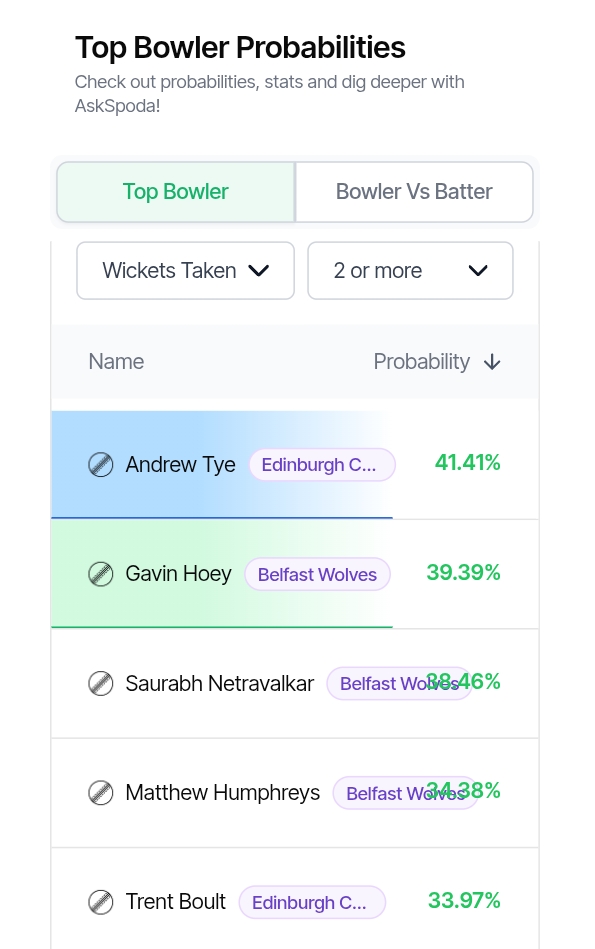
Why Andrew Tye has 41.41% Probability
Tye tops the model because his entire workload sits right in the highest-risk phases of T20 cricket: the backend death overs. When batters swing blindly at everything in overs 17 through 20, his bag of deceptive tricks routinely turns wild slogs into simple catches in the deep.
The Blueprint: He changes pace without altering his arm speed, relying on his signature knuckleball, wide off-stump yorkers, and looping back-of-the-hand slower deliveries. On a sticky, two-paced European track, batters cannot generate their own power against his off-pace cutters.
Current Form & Analytics: A master franchise mercenary with over 300 career T20 scalps and a lifetime average around 21.50. In matches where Edinburgh defends or closes out innings, his probability of cleaning up multiple trailing tailenders spikes past 40%.
Why Gavin Hoey has 39.39% Probability
Hoey is Belfast’s premier strike weapon through the middle overs. Modern wrist-spinners are prized wicket-takers in 20-over cricket, and Hoey attacks the stumps with relentless aggression rather than just bowling defensively.
The Blueprint: He rips deliveries with sharp overspin and relies on an undercut googly that catches right-handers playing inside the line. The sluggish Voorburg pitch provides plenty of natural grip, generating uneven bounce that makes misjudging his length fatal.
Current Form & Analytics: In red-hot touch across international and representative cricket, highlighted by an impressive 4-wicket haul (4/34) against Afghanistan. He maintains a fierce domestic T20 strike rate of a wicket every 15 deliveries.
Why Saurabh Netravalkar has 38.46% Probability
USA Cricket’s biggest star and tech-engineering hero remains one of the most bankable left-arm seamers on the global circuit. Known to American sports fans for dispatching elite international top orders, Netravalkar is built to strike twice in a single spell.
The Blueprint: Netravalkar creates a tight, natural angle that slants into right-handed bats before shaping slightly away off the seam. He attacks the top of off-stump with pinpoint discipline, forcing batters into tentative defensive pokes or mistimed lofted drives over mid-off.
Current Form & Analytics: Carried serious momentum into this clash after solid stints in Major League Cricket (Washington Freedom) and the Caribbean Premier League, where he posted a dominant 3/32 display. In his recent 4-over ETPL spell, he strangled opposition scoring, conceding just 24 runs (6.00 economy) with constant edges.
Why Matthew Humphreys has 34.38% Probability
Humphreys provides the squeeze that forces batters into rash mistakes. As an orthodox left-arm spinner, his job is to lock down one end, build scoreboard pressure, and cash in when frustrated hitters try to manufacture risky boundaries.
The Blueprint: Rather than tossing the ball up wide, Humphreys bowls a flat, stump-to-stump line that cuts off the batsman’s swing arc. By denying batters room to free their arms, he forces rushed sweeps and miscued pulls directly to mid-wicket and long-on.
Current Form & Analytics: Rapidly establishing himself as Ireland’s most reliable white-ball spinner. Operating in tandem with Gavin Hoey gives Belfast a lethal spin combo, frequently yielding Humphreys consecutive wickets as batters try to target his overs.
Why Trent Boult has 33.97% Probability
Boult is a global powerplay assassin who can kill a run-chase inside the first twelve balls of a game. If any bowler on this list is primed to grab two wickets in a single over, it’s New Zealand’s swing maestro.
The Blueprint: Classic, vicious left-arm shape. Boult pitches the new ball up full outside off-stump, hooping it back through the gate to target the front pad and off-pole before batters are set. Later in the innings, he nails reverse-swinging blockhole deliveries.
Current Form & Analytics: In ruthless rhythm during this inaugural ETPL tournament, bagging 7 wickets in 3 matches at a sensational 6.29 average. That run is headlined by a match-winning 5/24 blitz against Glasgow, proving he remains one of the world’s most destructive multi-wicket threats.
What is the Squad Strength of Edinburgh Castle Rockers
The table-toppers rely on Kiwi leadership, disciplined swing bowling, and proven international all-round depth.
Top Order & Leadership: Commanded by New Zealand all-rounder Mitchell Santner, the top order is anchored by in-form veteran JJ Smuts and the dangerous Ross Adair. USA international Andries Gous and Scotland standout Brandon McMullen add consistency through the middle.
Finishing Power: Experienced English campaigner Laurie Evans teams up with Tom Curran and Mitchell Santner to provide clean striking and reliable runs in the death overs.
Bowling Strength: The pace attack is driven by Trent Boult, whose left-arm swing has dismantled batting lineups with seven wickets at an elite average early this season. For spin, captain Mitchell Santner pairs with Scotland’s crafty left-arm spinner Mark Watt to choke run rates on sluggish surfaces.
What is the Squad Strength of Belfast Wolves
The Wolves combine explosive international firepower with seasoned Irish match-winners to play an aggressive, high-tempo brand of cricket.
Top Order & Leadership
Led by dynamic captain Glenn Maxwell and veteran opener Paul Stirling, the top order can dismantle bowling attacks in the powerplay. New Zealand star Devon Conway and young talent Tim Tector add dependable anchor play and stroke-making upfront.
Middle Order & Finishing Power
Mark Chapman and South African powerhouse David Miller give the Wolves one of the most destructive middle-order pairings in the competition. Wicketkeeper Lorcan Tucker adds further flexibility and brisk scoring late in the innings.
Bowling Strength
The pace battery is led by death-overs specialist Chris Jordan, Dutch left-arm seamer Fred Klaassen, USA standout Saurabh Netravalkar, and Irish all-rounder Mark Adair. Rising Irish spinner Matthew Humphreys provides key wicket-taking threat through the middle overs.
Edinburgh Castle Rockers vs Belfast Wolves: Top Fantasy Picks
Top 3 Batters to Watch
1. Devon Conway (Belfast Wolves): Conway is the definition of top-order insurance. With a career T20 average near 40 and a strike rate around 128, his steady accumulation and placement allow Belfast to consistently build competitive totals. He anchors the innings against early swing, rotating strike cleanly before punishing bad balls through the off-side.
2. Andries Gous (Edinburgh Castle Rockers): Gous is the dynamic accelerator in the Edinburgh top order. Boasting a career T20 strike rate of 135+ and an average exceeding 32, he thrives on picking lengths early and dispatching seamers over deep mid-wicket. Fresh off a rapid 40 off 28 in the ETPL and a 51-ball 82 in recent franchise play, he is Edinburgh’s most dangerous boundary hitter.
3. Paul Stirling (Belfast Wolves): Stirling brings pure powerplay aggression. With over 8,500 career T20 runs and a 140+ strike rate, his game is built around early boundary blitzes that tilt momentum inside the first four overs. Having notched an unbeaten 25* in his last outing, he can dismantle opening bowling spells if he survives the initial swing.
Top 3 Bowlers to Watch
1. Trent Boult (Edinburgh Castle Rockers): Boult remains one of the world’s most lethal new-ball operators. Across a career of 270+ T20s with an economy below 8.0, his trademark is hooping full-pitched inswing into the pads of right-handers. He enters this match in blistering rhythm, having taken 7 wickets in just 2 games at a miserly 6.29 economy for Edinburgh.
2. Andrew Tye (Edinburgh Castle Rockers): Tye is the ultimate death-overs disruptor. With over 300 career T20 scalps, an economy around 8.15, and a lethal bag of knuckleballs and wide cutters, he turns wild backend hitting into mistimed catches. Operating during overs 17 to 20, he routinely picks up multiple wickets when chasing teams are forced to slog.
3. Saurabh Netravalkar (Belfast Wolves): Netravalkar provides surgical powerplay control. With a career T20 economy under 7.20 and a recent 4-over franchise masterclass conceding just 24 runs, his tight angle into right-handers consistently creates edges. He acts as Belfast’s disciplined spearhead, drying up boundaries and forcing top-order errors.
Final Verdict – Today Match Prediction
This clash hinged on Trent Boult’s powerplay swing versus Belfast’s explosive top order. While the Rockers hold a slight bowling edge through Boult and Santner, the Belfast Wolves possess superior middle-order firepower in Chapman and Maxwell, giving them the edge to chase down or defend any target on a tricky pitch.
Du Plessis combines veteran composure with high-tempo execution at the top of the order. Because he faces the first ball with field restrictions intact, his floor for scoring 30+ runs is consistently the highest on the board.
The Blueprint: Uses his fast hands to loft balls over mid-off inside the 6-over Powerplay, quickly rotating strike against spin before launching into long-off against seamers.
Current Form & Analytics: Across franchise leagues, including the U.S. Major League Cricket circuit, Du Plessis has maintained a robust strike rate north of 165 and an average over 35, showing rare consistency for an opener.
Why Heinrich Klaasen has 42.06% Probability
Klaasen is the most feared white-ball middle-overs batter in the world. His high probability despite batting at No. 4 or No. 5 stems from his ability to convert short 15-ball stays directly into 30+ run innings.
The Blueprint: He drops deep into the crease against express pace to access 360-degree boundary zones and steps cleanly down the track to hit spin straight back over the sightscreen.
Current Form & Analytics: Operating at a career T20 strike rate above 156 with an explosive boundary percentage in the death overs (250+ strike rate phase), he regularly crosses the 30-run mark in fewer than 20 balls.
Why Daryl Mitchell has 40.98% Probability
Mitchell acts as Dublin’s engine room. When the top order falters against hard new-ball lengths, Mitchell absorbs pressure before systematically taking down defensive bowling.
The Blueprint: Relies on powerful down-the-ground bat swings and high-elbow straight drives, punishing back-of-a-length deliveries with flat-batted pulls over wide long-on.
Current Form & Analytics: A central figure for New Zealand and top T20 leagues, Mitchell averages over 30 in high-leverage white-ball matches while striking near 140, making him Dublin’s safest run bank in the middle overs.
Why James Vince has 40.25% Probability
Vince is a technician who rarely throws his wicket away recklessly in the Powerplay. If Dublin avoids an early collapse, it is almost always because Vince anchored the first 8–10 overs.
The Blueprint: Feasts on slightly full seam bowling with classic, high-elbow cover drives, using delicate late cuts behind point to keep the scoreboard ticking against the spin choke.
Current Form & Analytics: Boasting over 11,200 career T20 runs with a steady 136.84 career strike rate, Vince enters the match having cleared 30+ runs in nearly half of his franchise innings over the past year.
Why Ben McDermott has 38.19% Probability
McDermott offers Rotterdam an aggressive top-order option whose game is tailored to maximizing the hard new ball.
The Blueprint: Sets a sturdy base to clear his front leg early, targeting the cow-corner boundary against incoming deliveries and dispatching short balls with authority.
Current Form & Analytics: Holding a high boundary-to-dot ratio in domestic T20 cricket, McDermott’s 38.19% line reflects his boom-or-bust nature: when he survives the initial swing burst, he routinely races past the 30-run threshold within the Powerplay itself.
Dublin Guardians vs Rotterdam Dockers – Top Bowlers (2+ Wickets)
Why Matt Hollard has 46.67% Probability
Hollard enters this contest with the highest probability on the board because he serves as Dublin’s go-to wicket-taker when an opposition innings starts gaining momentum.
The Blueprint: Uses subtle seam movement and a steep hitting deck from back-of-a-length, forcing batters into mistimed pulls and high-towering top edges.
Current Form & Analytics: Hollard leads Dublin’s bowling metrics with a standout average of 17.31. Because Dublin often defends modest totals, captain Ashwin entrusts him with high-leverage overs where attacking batters are forced to take risky chances against him.
Why Jai Moondra has 44.44% Probability
Moondra creates unique angles as Rotterdam’s premier left-arm seamer, an asset that consistently troubles right-handed heavy lineups.
The Blueprint: Swings the new ball back into the right-hander’s pads before switching to wide yorkers and cutters in the back half of the innings.
Current Form & Analytics: Holding an outstanding bowling average of 17.72, Moondra’s tight line chokes boundary options and regularly yields wickets in clusters during his second and third overs.
Why Anrich Nortje has 43.48% Probability
Nortje brings raw, 90+ mph heat that European pitch conditions struggle to neutralize, especially during overcast conditions in the Netherlands.
The Blueprint: Targets the stumps and ribs with aggressive, skiddy hard lengths that rush batters’ hands and lead to clean-bowled dismissals or splattered stumps.
Current Form & Analytics: Nortje has been in fiery wicket-taking touch in the tournament, already bagging 10 wickets in 3 matches, highlighted by a game-breaking five-wicket haul.
Why Craig Young has 42.10% Probability
Young brings veteran Irish international experience and a repeatable, upright seam presentation tailored to exploit any early moisture or grass covering on the pitch.
The Blueprint: Relies on probing fourth-stump lines in the first six overs to find the outside edge of aggressive openers, later utilizing disguised knuckleballs at the death.
Current Form & Analytics: A long-time spearhead in European white-ball conditions, Young regularly operates in the most wicket-friendly phases (overs 1–4 and 18–20), giving him multiple looks at fresh batters taking high-risk swings.
Why Sandeep Lamichhane has 35.16% Probability
While Lamichhane is Rotterdam’s premier spin weapon with a lethal 16.90 average, his slightly lower probability for a multi-wicket haul (2+) reflects the tactical respect opponents show him: teams often prefer to push singles rather than attack him recklessly.
The Blueprint: Relies on a rapid arm action and an indistinguishable googly that spins sharply through the gate of front-foot defensive prods.
Current Form & Analytics: Lamichhane regularly chokes the scoring rate below 7.00 an over in the middle phase. When Dublin’s lower-middle order is forced to hit out against him to accelerate the run rate, his chance of snatching two or more wickets spikes dramatically.
What is the Squad Strength of Dublin Guardians
The Dublin Guardians are desperate for their first victory of the tournament, relying on a solid technical core to overcome early-season batting collapses.
Top Order & Leadership: Led by tactical mastermind Ravichandran Ashwin, the batting order is anchored by the classical James Vince. Vince’s ability to stabilize an innings after early pressure provides a solid platform alongside explosive UAE opener Muhammad Waseem.
Finishing Power: The middle and lower order features the international experience of Daryl Mitchell and all-rounder Vijay Shankar. While they have struggled for collective rhythm across the opening matches, Mitchell provides essential boundary-hitting capability in the final overs.
Bowling Strength: The seam attack is spearheaded by Irish international Josh Little and break-out strike bowler Matt Hollard, whose partnership-breaking ability remains Dublin’s biggest weapon. For spin, captain Ashwin dictates the middle overs with control and variation, supported by Ireland regular George Dockrell.
What is the Squad Strength of Rotterdam Dockers
The Dockers boast a star-studded South African spine paired with premier Dutch international talent and aggressive power-hitters throughout the middle order.
Top Order & Leadership: Led by veteran captain Faf du Plessis, the top order blends the captain’s proven match-winning poise with explosive Dutch opener Michael Levitt and Australian batter Ben McDermott.
Finishing Power: Explosive South African striker Heinrich Klaasen and Donovan Ferreira provide world-class finishing firepower, supported by experienced all-rounder David Wiese and Ben Manenti to score rapid runs in the final stretch.
Bowling Strength: Express fast bowler Anrich Nortje spearheads the pace department alongside Dutch all-rounder Logan van Beek and Ryan Klein. The spin attack is driven by veteran left-arm spinner Roelof van der Merwe and leg-break specialist Sandeep Lamichhane to stifle runs and force breakthroughs.
Dublin Guardians vs Rotterdam Dockers: Top Fantasy Picks
Top 3 Batters to Watch
James Vince (Dublin Guardians)
Role & Profile: Top-order anchor; serves as the stabilizing force who anchors the innings while maintaining a healthy scoring tempo.
Key Stats from Match Preview: 11,251 career T20 runs with a steady 136.84 strike rate.
Form & Impact: Known across global franchise circuits (The Hundred, BBL, PSL) for his technical elegance, he acts as Dublin’s primary accumulator capable of blunting early swing and batting deep into the innings.
Heinrich Klaasen (Rotterdam Dockers)
Role & Profile: Middle-to-death overs powerhouse; designated “force multiplier” capable of altering the contest in a single over.
Key Stats from Match Preview: Blistering career T20 strike rate of 156.86.
Form & Impact: One of the most destructive spin and pace hitters in white-ball cricket. He is lethal if deployed in the middle overs (overs 11–20), making him the Dockers’ chief weapon to turn competitive totals into match-winning scores.
Faf du Plessis (Rotterdam Dockers)
Role & Profile: Captain and opening anchor; provides leadership, experienced tempo control, and aggressive powerplay capitalization.
Key Stats from Match Preview: Over 10,000 career T20 runs with a high-calibre average of 35.56.
Form & Impact: Du Plessis excels at rotating strike early before transitioning into boundary-hitting gears. His reliability makes him the safest bet to build the foundation for Rotterdam’s heavy-hitting middle order.
Key Stats from Match Preview: Elite bowling average of 16.90.
Form & Impact: Lamichhane brings sharp variations, quick googlies, and a proven ability to choke the scoring rate. He poses the biggest tactical threat to Dublin’s middle order during the middle phase.
Key Stats from Match Preview: Exceptional bowling average of 17.31.
Form & Context: An emerging strike bowler in Irish/European cricket, Hollard has proven to be high-impact across the powerplay and middle overs, regularly delivering breakthrough wickets when an innings threatens to get away.
Key Stats from Match Preview: Tight bowling average of 17.72.
Form & Context: Providing left-arm angle and sharp seam movement, Moondra combines tight containment with wicket-taking efficiency. Alongside Lamichhane, he gives Rotterdam control through the critical scoring phases.
Final Verdict – Today Match Prediction
Rotterdam enters the match as heavy favorites. While Dublin has the bowling depth in Ashwin and Hollard to trouble top batters, Rotterdam’s batting firepower—driven by Du Plessis and finished by Klaasen—combined with Lamichhane’s spin control gives them a distinct tactical edge across both innings. Dublin will need James Vince to bat deep and early wickets from Josh Little to pull off an upset.