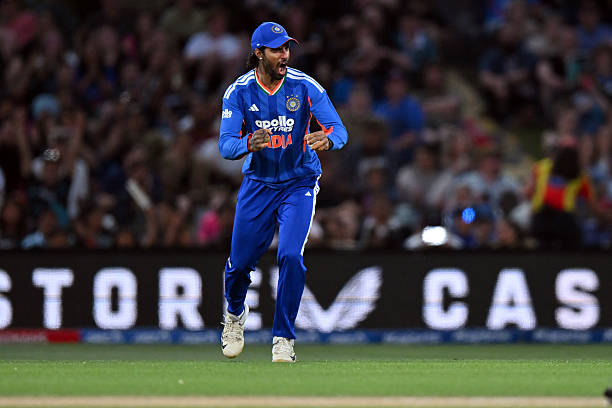
Tilak Varma. There’s two kinds of Tilak Varma you might have watched over the past three years. A version in 2024/25, where he asked for a promotion to three and ransacked two consecutive T20I hundreds against South Africa in South Africa.
The other one; a player who looks feeble against spin since 2026, but against pace, brutal like no other, finding gaps and power you could not imagine.
His numbers against spin have been a cause for great concern for India and for the Mumbai Indians in 2026, having forced both those teams to relegate him lower down the order.
At the same time, he has managed to re-invent himself, having gone from batting well at 3/4 down to being an excellent number six, with his numbers against spin now flagging.
Difference based on Batting Position
The difference between positions is obvious, Varma has gone from preferring to bat three, where he averaged 70 and struck at 155.5, to ideally performing at six, striking at 197.6 where he has averaged 81.
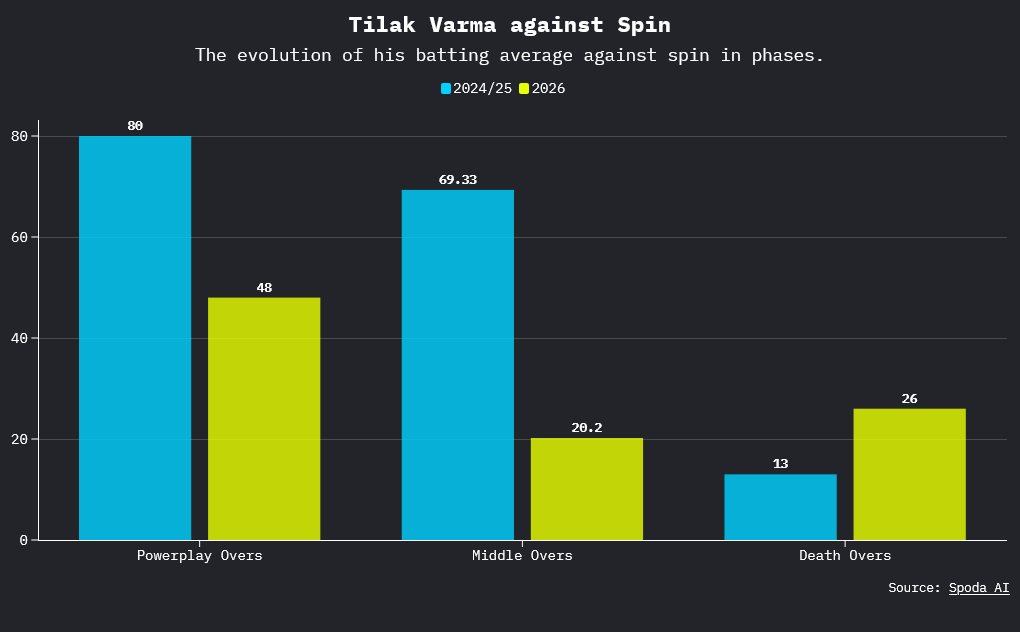
The change in his preference has come down to his ability in being able to play the spinners, from being able to milk them easily and score consistently in the 2024/25 season, to struggling against them in 2026.
While his numbers against pace have improved significantly, having turned himself into an elite pace hitter.
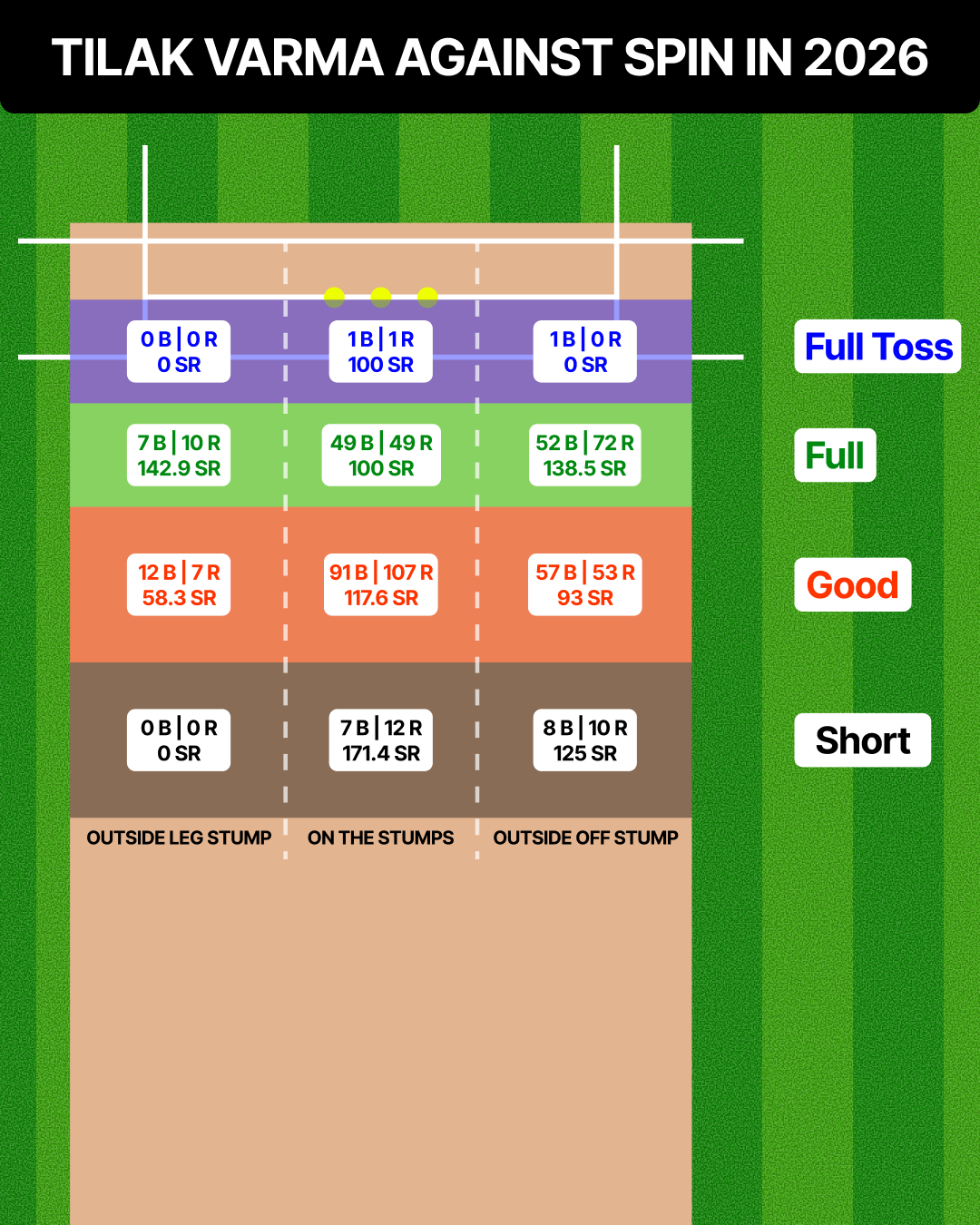
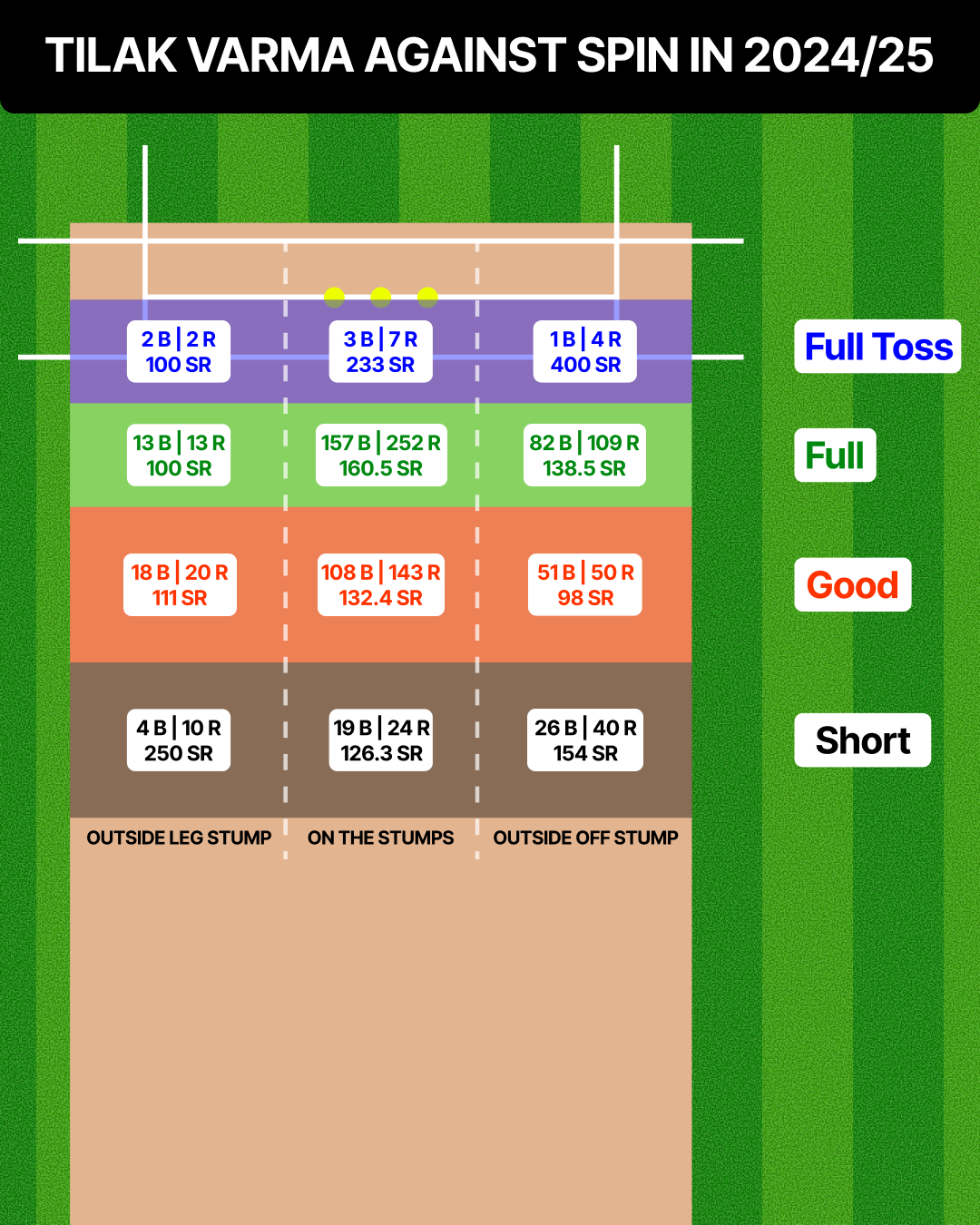
The following pitch-maps illustrate the difference between his performances from 2024/25 to 2026.
The largest paradigm shift in his ability against spin has been his ability to get under a ball, where he used to strike at 160.5 against balls pitched full on the stumps, the same numbers now sit at a strike rate of 100.
All in all, Tilak Varma had scored 426 runs against balls from spinners targeting the stumps at a strike rate of 148.4, which has fallen to 114.2 over the course of this year.
Another region of concern has been bowlers who have bowled at a good length, targeting his knee roll, a combined strike rate of 104.4 this year, while previously, this strike rate was 120.3.
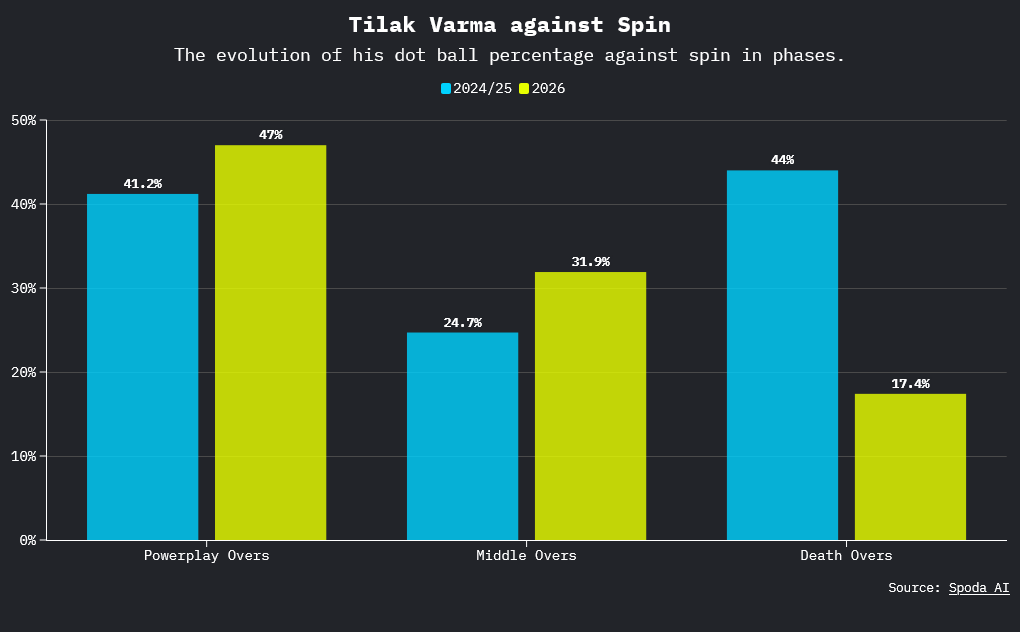
His ability to find the boundary has been a significant cause for concern against spin, with the percentage of dots faced in the middle overs having gone up from 25% in 2024/25, to 32% in 2026.
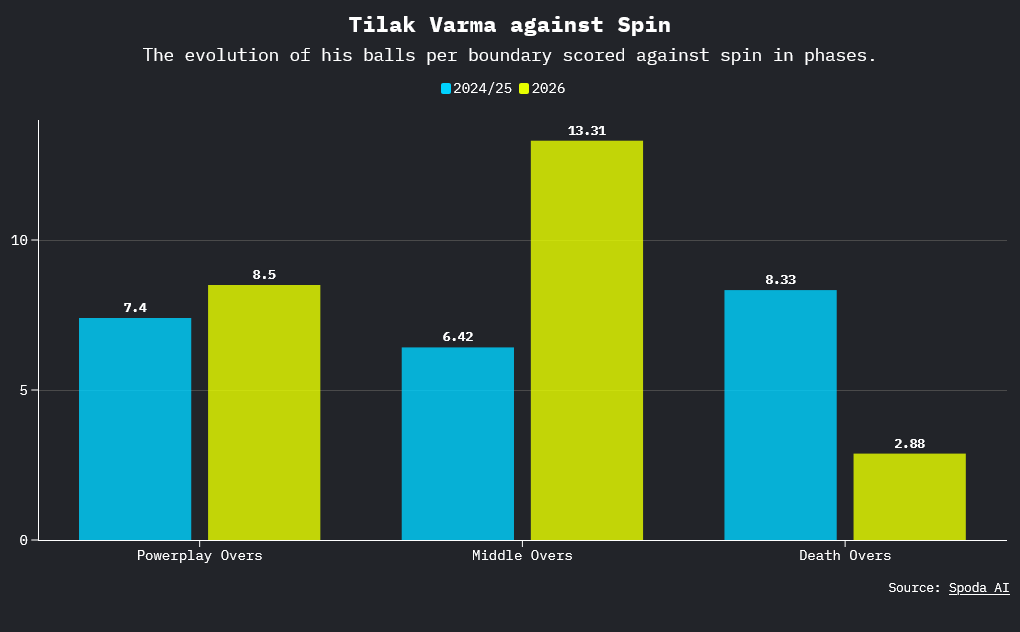
His balls per boundary found against spin in the middle overs has doubled too, having found the ropes once every 6.4 balls in 2024/25, now Tilak has required 13.3 balls per boundary.
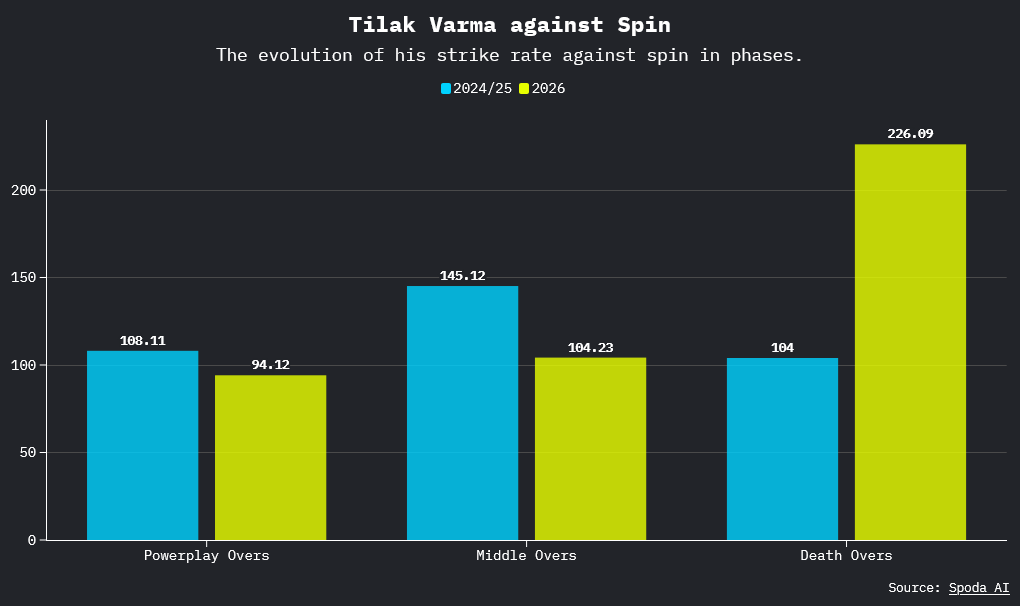
The evolution of his strike rate against spin has been the most damning evidence of his ability cap against the style of bowling having dropped.
With Hardik Pandya often injured, and India having a surplus of top-order batters in Shreyas Iyer, Rajat Patidar, Ishan Kishan, Vaibhav Sooryavanshi, Abhishek Sharma, Sanju Samson and the uncapped pair of Priyansh Arya and Prabhsimran Singh, this is a great head-ache for the Indian selectors to have.
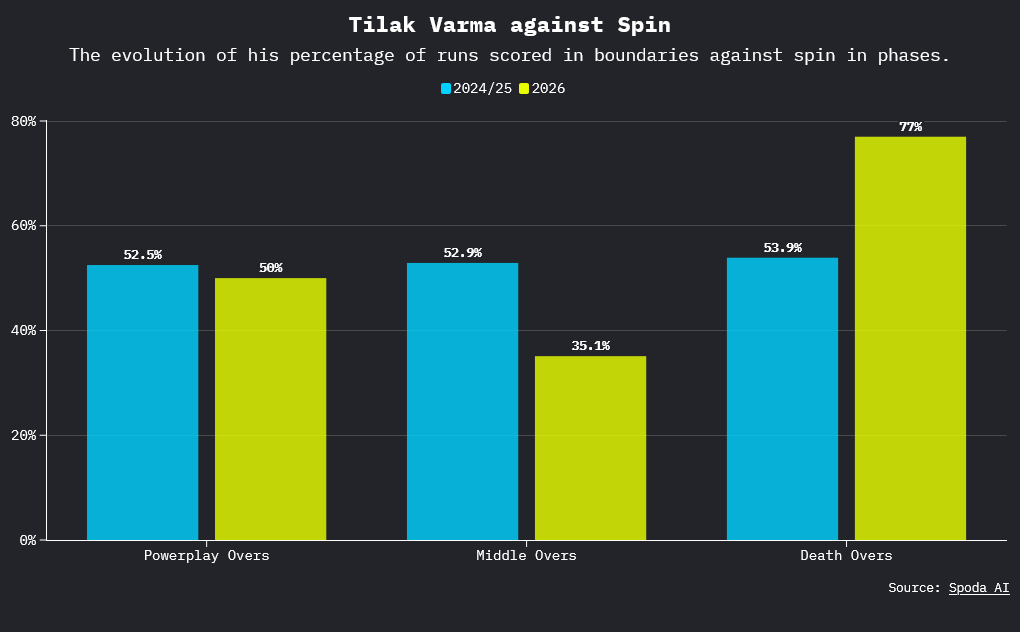
His ability in the death overs has allowed for the Indian side to use him in a specialised role where he has been excellent, allowing India to not worry about their ability to finish off innings.
He presents a case to be moved down the order at his IPL team too, which might be a vital move with the trade rumours surrounding Hardik Pandya and the Mumbai Indians.
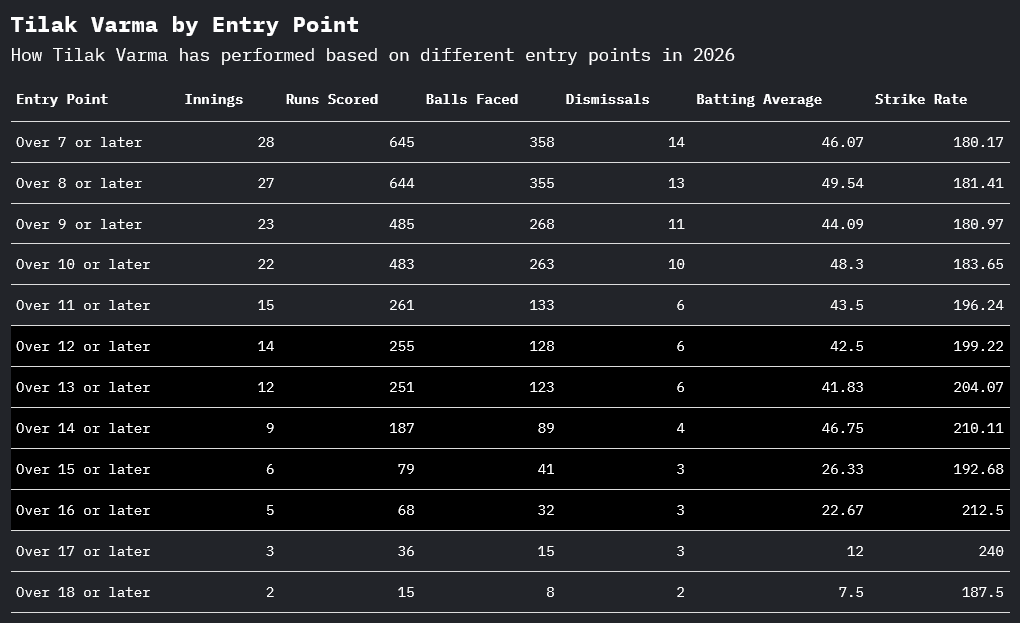
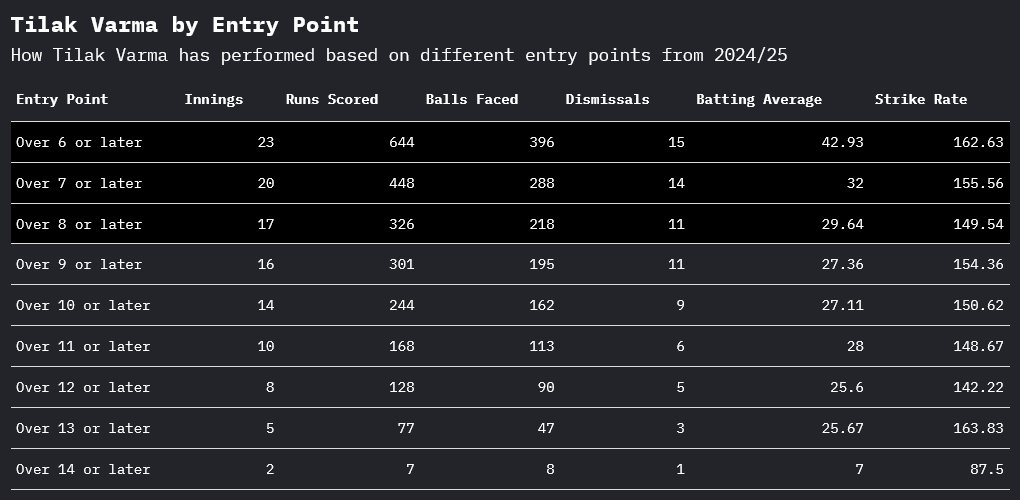
The above chart highlights his performances based on his entry point through the two periods of play, with a significant lift in performance once he walks in after the 10th over.
Spoda AI is your AI assistant for cricket analysis, specializing in T20s and ODIs. Visit us on www.spoda.ai now and ask away all your cricketing queries!
India vs England- Top Batters to Watch (30+ Runs Probability)
Why Abhishek Sharma has 45.83% Probability
The statistical frontrunner for India, Abhishek Sharma represents the absolute cutting edge of modern T20 opening intent. His capability to exploit field restrictions makes him a premier choice to secure a 30+ score.
The Blueprint: He utilizes an incredibly high backlift and minimal footwork to clear the infield over the off-side and down the ground.
Current Form & Analytics: Scoring at a blistering strike rate early in the innings, his 30-run contributions arrive quickly, mitigating long-term risk against standard defensive fields.
Why Jos Buttler has 40.00% Probability
With a 40.00% probability, Buttler remains the definitive bedrock of England’s white-ball batting philosophy, bringing a masterclass combination of world-class experience and 360-degree shot-making.
The Blueprint: He balances early technical defensive stability against the swinging ball with unmatched acceleration capacity once settled.
Current Form & Analytics: Coming off a solid 36 runs off 21 balls in the 3rd T20I, his calculated deep-crease positioning makes him a safe bet to build a substantial foundation.
Why Phil Salt has 38.60% Probability
Salt is entirely defined by his uncompromising attacking intent at the top of the order alongside Buttler. If he survives the opening burst, he can entirely alter the match trajectory.
The Blueprint: He shifts his weight rapidly onto the back foot to punch pace through the covers or drag back-of-length deliveries over mid-wicket.
Current Form & Analytics: He is in sensational form, smashing a brilliant 70 runs off 44 balls in his previous outing, demonstrating his supreme boundary-clearing capabilities.
Why Ishan Kishan has 38.00% Probability
Showing impressive confidence and intent, Kishan provides India with an alternate left-handed explosive engine in the top-tier batting order.
The Blueprint: He relies on strong wrist work and base stability to hit through the line of the ball, making him lethal against short-pitched bowling.
Current Form & Analytics: Having scored a quick 13 runs off 9 balls in the last match, he possesses a knack for finding gaps square of the wicket to keep the scoreboard ticking over consistently.
Why N. Tilak Varma has 35.29% Probability
Tilak Varma is quickly cementing his role as a vital middle-order presence capable of handling structural collapses or accelerating at a moment’s notice.
The Blueprint: An exceptional player of both traditional and mystery spin, he utilizes sweep variations and nimble footwork to disrupt defensive spinners.
Current Form & Analytics: His high-percentage cricket minimizes reckless dismissals, keeping his floor high and making him a reliable option to anchor the innings under tough English conditions.
Sitting on top with a flawless probability score, the rising quick is expected to be India’s biggest threat.
The Blueprint: Fresh off his breakthrough IPL 2026 campaign where he bagged 16 wickets in 14 matches, his ability to extract bounce is unmatched.
Current Form: He broke into the playing XI in the previous T20I and holds the ultimate x-factor with a lethal, toe-crushing yorker in his arsenal.
Why Varun Chakaravarthy has 51.11% Probability
The mystery spinner remains India’s primary weapon to put the brakes on England’s aggressive middle order.
The Blueprint: His web of variations makes him incredibly difficult to read, forcing batsmen into desperate, risky shots.
Current Form: Possessing a knack for chipping away with multi-wicket breakthroughs, he remains a statistical favorite to clean up the middle order.
Why Prasidh Krishna has 50.00% Probability
Krishna brings the essential element of raw pace and steep bounce that can rattle any batting lineup.
The Blueprint: His high release point allows him to exploit the hard lengths, a trait that works exceptionally well on testing tracks.
Current Form: Returning to international assignments with sharp intent, he holds a highly encouraging 50% probability of leaving a serious dent in England’s scorecard.
Why Josh Tongue has 50.00% Probability
The English speedster provides the host nation with an incredibly reliable option to exploit home advantages.
The Blueprint: He specializes in hitting a hard length right from the get-go, testing the defenses of top-order batsmen.
Current Form: Featured in England’s recent tactical plans, his command over traditional English movement positions him perfectly to snare multiple wickets.
Why Arshdeep Singh has 48.28% Probability
The left-arm seamer serves as India’s premier weapon across both the powerplay and the death overs.
The Blueprint: His unique angle paired with sharp tailing-in swing makes him an immediate danger to right-handed openers.
Current Form: As India’s leading frontline seamer in the series, his clutch execution at the death secures him a robust 48.28% chance of cleaning up the tail end.
What is the Squad Strength of India
The touring side has looked to rebuild with fresh, aggressive talent while struggling heavily to establish rhythm on the fast English tracks.
Top Order & Leadership: Led by captain Shreyas Iyer, the batting relies on him and his vice-captain Tilak Varma to lay down a solid foundation. They also possess the dangerous Abhishek Sharma, who brings immense attacking intent to the top of the order.
Finishing Power: Wicketkeeper-batsman Sanju Samson alongside the experienced powerhouse Shivam Dube form the core finishing unit, capable of hitting massive maximums and injecting quick runs at the back end of the innings.
Bowling Strength: In the absence of Jasprit Bumrah, the pace attack is spearheaded by the left-arm swing of Arshdeep Singh and the raw energy of Haris Rana. For the spin department, India counts on the mystery elements of Varun Chakravarthy and the clever lengths of Ravi Bishnoi.
What is the Squad Strength of England
The hosts have focused on utilizing their explosive batting firepower while riding high on the momentum of back-to-back dominant victories over the visitors.
Top Order & Leadership: Led by their newly appointed captain Harry Brook, the explosive batting is anchored by him and the experienced opener Jos Buttler. They also have the ultra-aggressive Phil Salt at the top, who can change the complexion of a game within the first few overs of the powerplay.
Finishing Power: Liam Dawson and the hard-hitting young talent Jacob Bethell remain highly reliable options in the lower-middle order, providing late-innings stability and explosive clearing of the boundary ropes.
Bowling Strength: The pace attack is led by the dangerous Saqib Mahmood, who has been in devastating wicket-taking form this series, alongside the versatility of Luke Wood. For spin, they rely heavily on the elite experience of Adil Rashid and the variations of Rehan Ahmed.
Final Verdict – Today Match Prediction
With England leading the series comfortably following a massive 125-run victory in the 3rd T20I, they walk into Bristol as the overwhelming favorites. India’s recent batting collapse for just 76 runs highlights a deep vulnerability against England’s bowling attack. Unless Shreyas Iyer and his top-order can weather the early storm, England is highly expected to maintain their dominance and wrap up the series cleanly.
India vs South Africa T20 cricket prediction today brings a high-stakes clash between two power-packed sides featuring elite batters, match-winning bowlers, and proven all-rounders. With Suryakumar Yadav leading India and Aiden Markram captaining South Africa, this match promises intensity, pace, and tactical depth.
India’s Varun Chakravarthy (L) celebrates with captain Suryakumar Yadav after taking the wicket of South Africa’s Marco Jansen during the third Twenty20 international cricket match between India and South Africa at the Himachal Pradesh Cricket Association Stadium in Dharamsala on December 14, 2025. (Photo by Arun SANKAR / AFP via Getty Images)
This preview is powered by SPODA’s AI cricket tool engine and advanced cricket analysis software, designed to deliver accurate, data-backed insights for modern cricket fans.
India vs South Africa – Match Details
Match Type: Men’s T20
Teams: India vs South Africa
Format: T20 International
Prediction Model: SPODA AI
AI Cricket Prediction Summary – Win Probability
Scenario
India Win %
South Africa Win %
India bat first
76%
24%
South Africa bat first
78%
22%
Cricket Analysis Insight: SPODA’s cricket model strongly favours India in both innings scenarios due to their superior spin resources and middle-over dominance key factors in modern India cricket success.
Steady wicket fall is expected, particularly against spin in the middle overs an area where India excel.
Top Batters Prediction (30+ Runs)
Player
Team
Probability
Abhishek Sharma
India
44.83%
Quinton de Kock
South Africa
41.05%
Suryakumar Yadav
India
39.56%
Cricket AI Prediction : Abhishek Sharma’s aggressive powerplay scoring gives India early momentum. Suryakumar Yadav remains India’s most dangerous T20 batter, while de Kock anchors South Africa’s batting stability.
AI Cricket Insight: India’s spin duo of Varun and Kuldeep are the biggest wicket-taking threats, making India cricket statistically superior in T20 matchups against South Africa.
Aiden Markram (C), Quinton de Kock (WK), Dewald Brevis, Reeza Hendricks, David Miller, Tristan Stubbs, Corbin Bosch, Donovan Ferreira, Marco Jansen, George Linde, Ottneil Baartman, Keshav Maharaj, Lungi Ngidi, Anrich Nortje, Lutho Sipamla.
Final India vs South Africa T20 Prediction (SPODA AI)
Prediction Metric
Result
Predicted Winner
India
Match Impact Player
Varun Chakravarthy
Winning Margin
15–25 runs or 5–7 wickets
SPODA AI Verdict
Based on advanced analysis, India entered this contest as clear favourites. Their balanced batting, elite spin attack, and tactical depth give them a strong edge in today’s T20 encounter.
India’s captain Suryakumar Yadav reacts after his dismissal during the second Twenty20 international cricket match between India and South Africa at the Maharaja Yadavindra Singh International Cricket Stadium on the outskirts of Chandigarh on December 11, 2025. (Photo by Sajjad HUSSAIN / AFP via Getty Images)
South Africa will need exceptional performances from Quinton de Kock or Markram to challenge India’s dominance. However, SPODA’s AI cricket prediction continues to favour India cricket in this matchup.